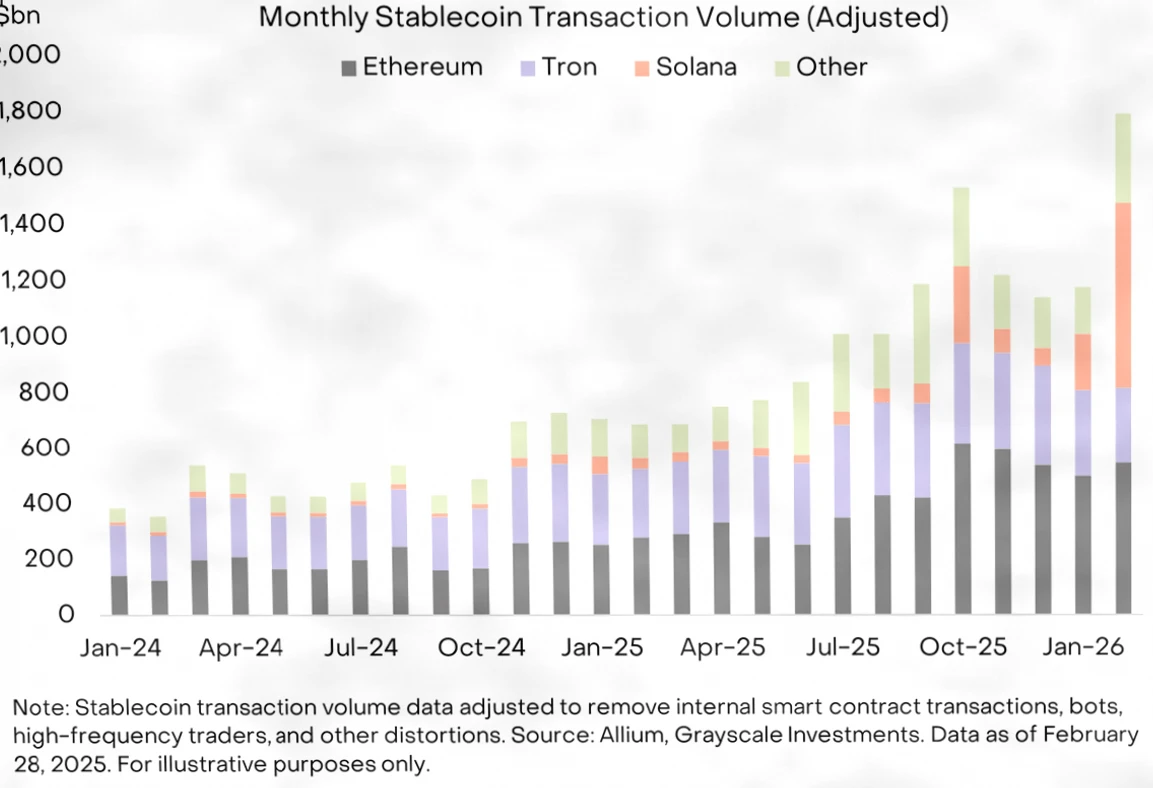
In February 2026, Solana surpassed Ethereum and Tron to become the world's leading stablecoin network with a monthly transaction volume of $650 billion, demonstrating its overwhelming advantage in high-frequency, small-value payments and revealing a profound transformation in the blockchain payment landscape.
According to Grayscale's latest report, in February 2026, the adjusted stablecoin transaction volume on the Solana network reached $650 billion, surpassing other major blockchains for the first time to become the public chain with the highest stablecoin transaction volume globally. During the same period, the total stablecoin transaction volume across the entire network was approximately $1.8 trillion, an increase of nearly 4.8 times compared to $375 billion in January 2024.
Looking back over the past two years, the stablecoin transaction landscape has undergone significant changes. In early 2024, Ethereum (dark gray) and Tron (purple) dominated the market, with Solana's (orange) share being almost negligible. However, by February 2026, Solana's share had jumped to become the largest segment, with its transaction volume growing rapidly. While Ethereum's absolute value increased from approximately $125 billion to $525 billion, its share continued to decline. Tron remained stable until the end of 2025, after which it experienced a slight rebound.
It is important to note that the above data is "adjusted transaction volume," which has been adjusted to exclude non-economic activities such as internal smart contract calls, bot transactions, and high-frequency arbitrage, providing a more realistic reflection of actual payment and transfer value. This adjustment makes the data more meaningful and avoids overestimating on-chain activity.
Solana's rise is attributed to its low fees and high throughput, making it an ideal choice for small, high-frequency stablecoin transactions, especially in scenarios such as payments and cross-border remittances, where it is more economical than Ethereum's high Gas fees. Tron previously dominated USDT circulation in Asia and emerging markets with similar advantages, but now Solana is rapidly seizing this track with a more efficient architecture.
More importantly, the growth in Solana's share is not a sudden occurrence. Its curve has been steadily rising since October 2025, and the surge in February 2026 is a natural continuation of the trend, rather than an isolated event. In addition, institutions such as PayPal have begun using the Solana network to achieve same-day settlement for truck drivers, indicating that stablecoins are moving from financial experiments to real economic infrastructure.
This trend also echoes current regulatory developments. Recently, U.S. politicians have called for the rapid development of a stablecoin legislative framework. Data shows that in 2025 alone, stablecoin issuers in the Ethereum ecosystem generated $5 billion in revenue, while the average monthly transaction volume across the network has approached $1.8 trillion. Stablecoins are no longer a fringe innovation within the crypto space but a core engine reshaping global capital flows.
0 comment A文章作者M管理员
No Comments Yet. Be the first to share what you think
❯
Profile
Search
Checking in, please wait...
Click for today's check-in bonus!
You have earned {{mission.data.mission.credit}} points today