

The largest USDC wallets on Ethereum have recently reached their highest concentration levels since 2022, with a staggering $32.7 billion now held across just 100 addresses. This accumulation scale is significant and warrants attention.
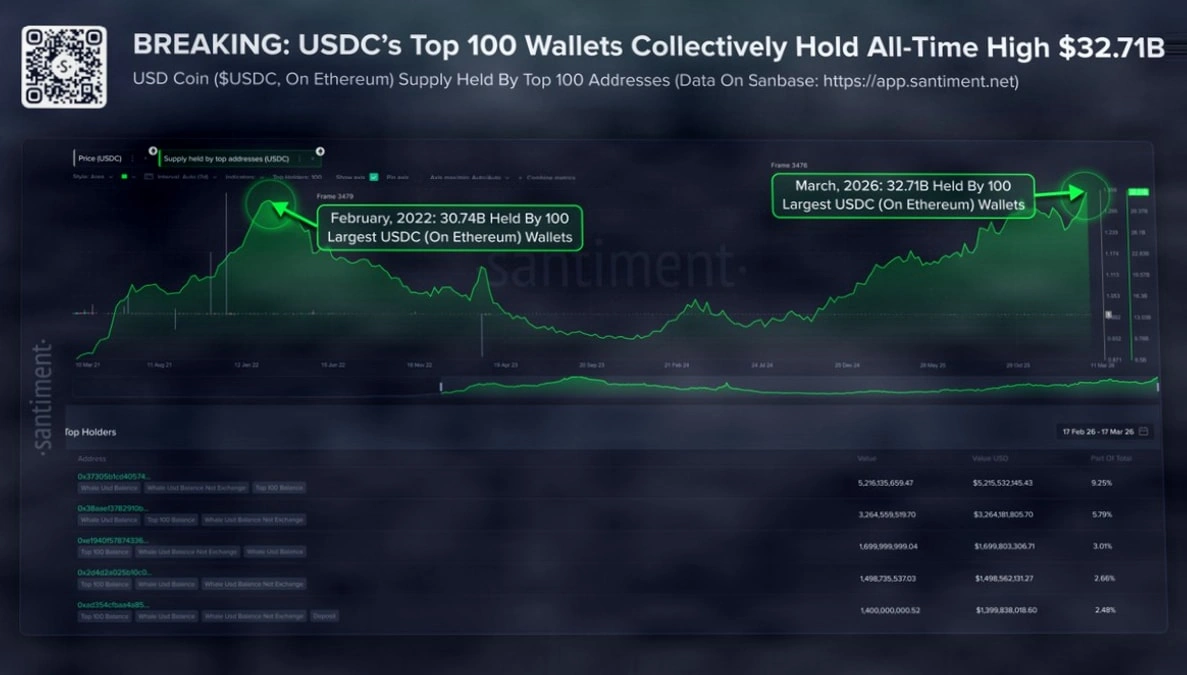
Such a high degree of concentration is not accidental. When large market participants—including institutions, family offices, trading desks, and crypto funds—simultaneously move such substantial capital into stablecoins, it typically signals one of two scenarios: either they are awaiting a specific catalyst to invest in risk assets, or they have found a new sense of security in holding the asset.
Currently, both interpretations are plausible and not mutually exclusive.
Circle's Minting Activity
The story of this accumulation isn't just about the transfer of existing supply between wallets. Circle, the company behind USDC, has also been actively minting new tokens. In the first week of March 2026 alone, over $3 billion in new USDC was created. One minting transaction on March 11th added $250 million in USDC in a single instance.
The current circulating supply stands at approximately $79 billion, having grown by about 8% in the past month alone. This growth rate is particularly notable when compared to Tether (USDT), which, despite its larger overall market cap of around $184 billion, is growing at a slower pace. The gap in actual economic usage between the two is narrowing faster than anticipated.
In fact, if we compare actual transfer volume rather than just market capitalization, USDC has already taken the lead. It now accounts for 64% of the adjusted transfer volume among the top two stablecoins—$22 trillion compared to Tether's $13 trillion. Market cap tells you who is bigger, while transfer volume tells you who is being used more. By this metric, USDC is winning.
Why Regulatory Clarity Changed Everything for USDC
Circle is a US-registered and heavily regulated company. USDC is the most likely stablecoin to meet the compliance standards of the GENIUS Act. For institutions that have been hesitant to hold stablecoins in large quantities due to regulatory risks, this exemption removes the last significant legal concern for holding USDC.
In short: From a US regulatory perspective, USDC has now become the safest large-cap stablecoin. On-chain data suggests institutional players immediately recognized this.
Injective Introduces Native USDC and Circle's CCTP — Bridged Assets Removed
Stablecoins as Infrastructure: A Broader Perspective
If we zoom out further, the USDC story is actually part of a larger trend. As of March 17th, the total on-chain value of tokenized real-world assets (RWAs) reached $27.05 billion, a new all-time high. Stablecoins like USDC serve as the primary liquidity bridge for this ecosystem, acting as the dollar-denominated medium through which tokenized Treasuries, real estate, and credit products are bought and sold on-chain.
As the RWA market grows, so does the demand for a reliable, regulated, and legally clear stablecoin to serve as its settlement layer.