

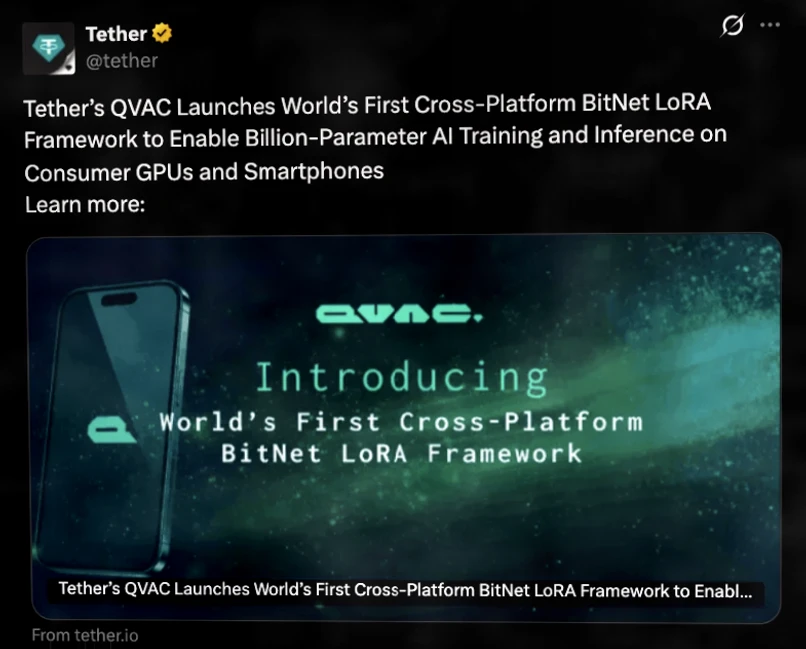
The latest development of Tether QVAC AI brings artificial intelligence closer to everyday users, allowing large models to run directly on smartphones and consumer hardware. This technology, launched by Tether's expanding AI team, eliminates the need for cloud processing, supporting training and inference on devices, whether it's a smartphone, laptop, or standard GPU.
QVAC Fabric is the core of this release; it is the engine behind Tether QVAC, integrating BitNet LoRA, capable of fine-tuning and running AI models with up to billions of parameters on consumer-grade GPUs and flagship smartphones. This system enables developers to run and fine-tune large language models on local consumer hardware, avoiding the need for expensive cloud infrastructure.
Previously, training and deploying advanced models required dedicated data centers or high-performance GPU clusters, but the launch of Tether QVAC AI significantly reduces these requirements. The framework supports various hardware, including AMD and Intel GPUs, Apple Silicon, and mobile chipsets, and is compatible with major operating systems, allowing developers across different platforms to take advantage of it.
Tether's goal is clear: to enable users and businesses to create and execute AI on their existing machines without transferring sensitive information to third-party servers.
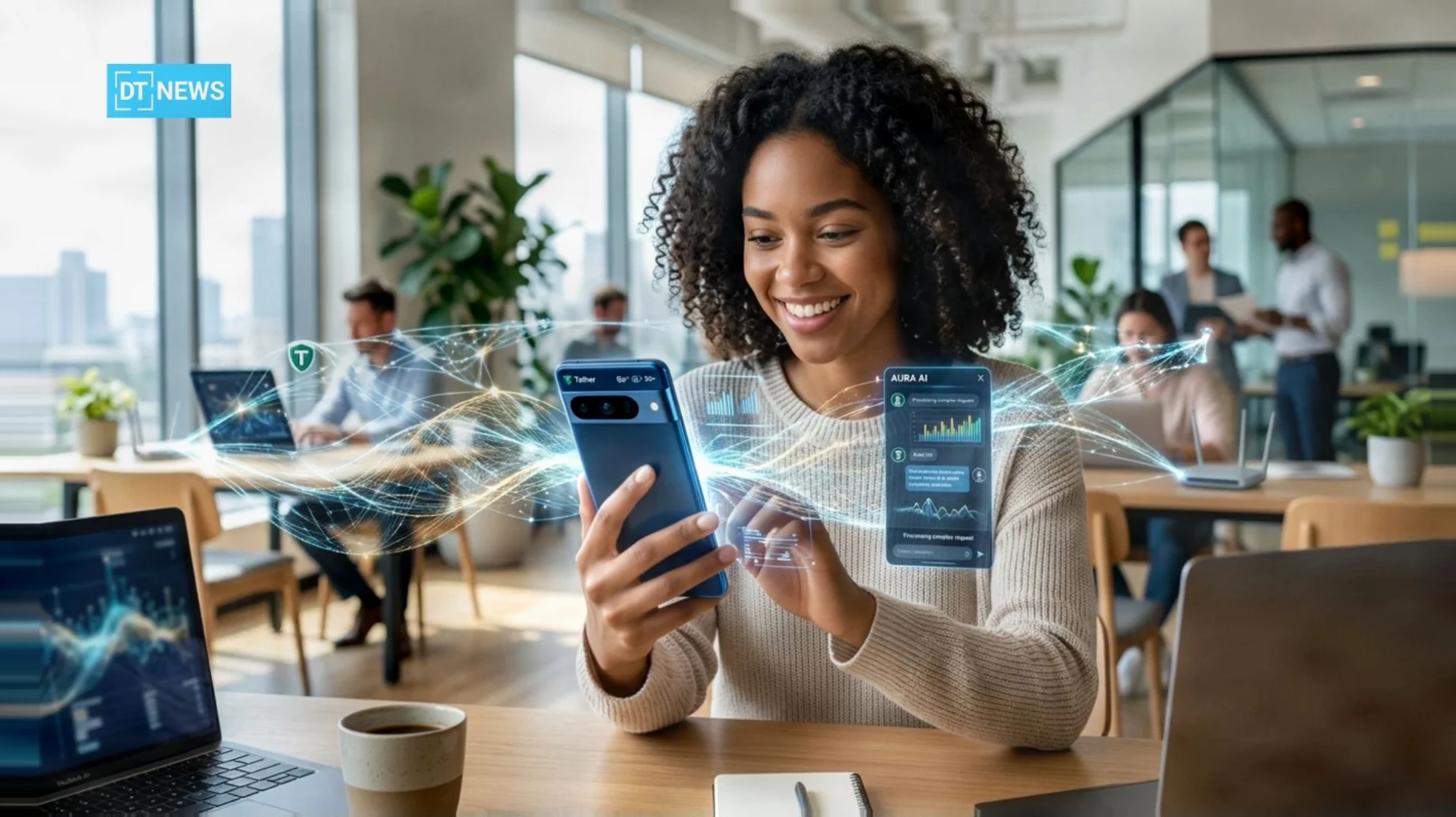
Billion-scale AI models are now operable on smartphones
One remarkable aspect of Tether QVAC AI is its ability to run on devices that traditionally could not support such large-scale models. The system allows fine-tuning on mobile GPUs, the very chips used in modern smartphones. This means AI models can be trained and adapted directly from the phone without relying on external computing power.
The Tether team has reported successful fine-tuning of models with up to 3.8 billion parameters on devices like the Pixel 9, Galaxy S25, and iPhone 16, with the iPhone 16 achieving a fine-tuning parameter count of 13 billion. This technological breakthrough contrasts sharply with current industry practices, where most mobile AI tools either rely on smaller models or depend on cloud computing for complex tasks.
Tether QVAC AI's support for larger local models means smartphones are not just simple AI interfaces; they are gradually becoming complete AI processing units. This will provide users with faster responses, better personalized experiences, and enhanced privacy protection, as data will remain on the device.
Open-source drives greater access for developers
Open-source is another highlight of the Tether QVAC release. The framework has been released under the Apache 2.0 license, allowing developers to freely use and modify the system according to their needs.