

Analysis charts reveal Bitcoin market dynamics.
The chart illustrates the monthly supply changes of Bitcoin (BTC) from January 2025 to March 2026. Global Exchange Traded Products (ETPs) are represented in green, and Treasury companies in purple. New supply, the amount of Bitcoin produced by miners each month, is shown as a cyan area below the zero line, reflecting a monthly issuance of approximately 13,500 BTC post-halving. Net institutional demand is depicted by a dark blue line, calculated as global ETPs plus Treasury company purchases, minus new supply.
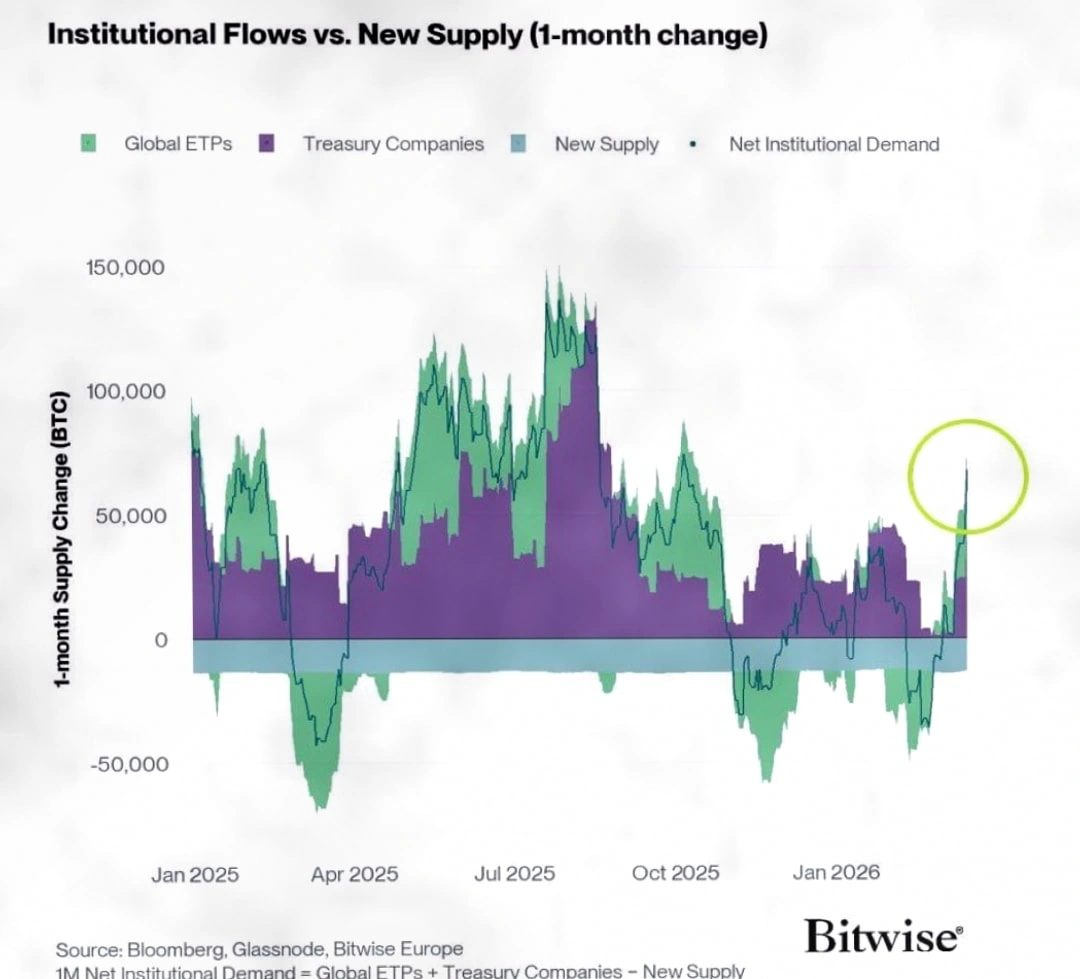
Between January and October 2025, the chart shows significant fluctuations in institutional demand. Around July and October 2025, the monthly changes in the green ETP area peaked at nearly 100,000 to 150,000 BTC, the largest increases visible on the chart. These periods coincided with strong price performance indicated by broader market data.
Subsequently, the market experienced a notable correction. From October 2025 to January 2026, both the green and purple ETP and Treasury purchase areas saw sharp contractions. During this time, the net institutional demand line dipped below zero, with the dark blue line falling below the baseline. This synchronized with market downturns, as Bitcoin retreated from its all-time highs to the $60,000-$65,000 range by early 2026.
The latest data points near March 2026 on the right side of the chart (highlighted with yellow circles) show a sharp rise in the green ETP area, pushing the total institutional demand reading back to 50,000 to 60,000 BTC per month. This peak supports the assertion that institutional demand is three times higher than new supply. Post-halving, new Bitcoin supply is approximately 13,500 BTC per month. Institutional demand of 50,000 to 60,000 BTC per month is roughly 3.7 to 4.4 times that amount.
Historical Comparison and Current Context Differences
Analysis from Rand Group indicates that similar patterns have occurred previously. The chart shows that in early 2025 (approximately January to February of that year), there was a similar peak in net institutional demand relative to new supply. Records from that time indicate that Bitcoin's price doubled within four months of this reading appearing. Although price information is not directly displayed on the chart, the demand peak in early 2025 is clearly visible and did occur prior to Bitcoin's rise to its October 2025 high.
This historical parallel forms a data-supported bullish argument. However, it is merely a historical precedent and not a statistically significant repeatable pattern. A single instance is insufficient to establish a reliable rule, but it provides a precedent worth noting.
Current Context Complicates Comparison
The previous demand surge occurred amidst expectations of interest rate cuts and improving macroeconomic conditions. The current surge, however, is happening with Bitcoin prices below $70,000 and the Federal Reserve anticipating only one rate cut for the remainder of 2026.