

According to data analysis from CryptoQuant, Binance Bitcoin's Open Interest, on a 30-day rolling Z-Score basis, shows its 30-day moving average has fallen to approximately $6.91 billion, marking the lowest level since October 2024. The total open interest currently stands at $7.33 billion, indicating the derivatives market is undergoing a "repositioning phase" rather than a clear directional trend, as described by on-chain analyst ArabxChain.
Chart Interpretation
The chart covers the period from November 2024 to mid-March 2026, comparing four key metrics against Bitcoin's price action, represented by the black line. The green bars represent daily open interest in BTC terms; the red line depicts the 30-day rolling average of open interest in USD terms; the blue line tracks the 30-day standard deviation; and triangle markers indicate the Z-Score, which measures the deviation of current open interest from its recent historical average.
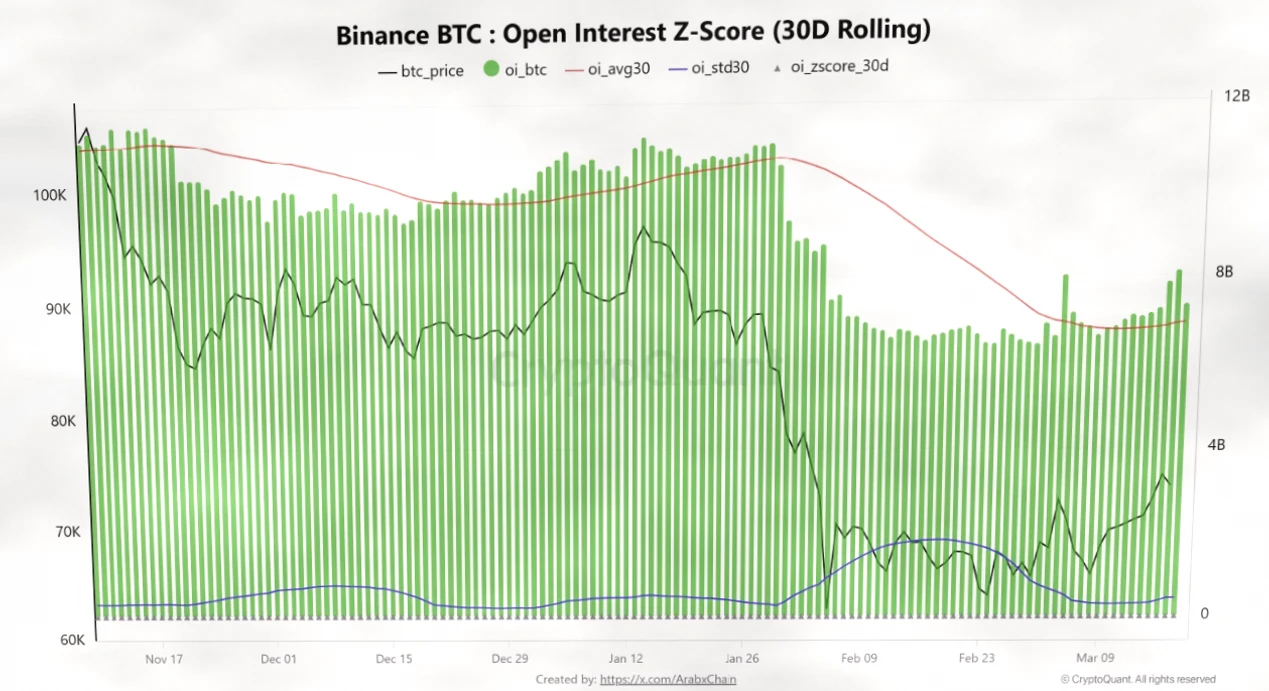
From early November to late January, the open interest shown by the green bars remained consistently high, generally above the $8 billion level indicated by the right-side y-axis. Concurrently, the red 30-day average line hovered between $10 billion and $11 billion. During this phase, Bitcoin's price fluctuated between $90,000 and $107,000, corresponding to the cycle high noted in the upper left of the chart. The synchronized rise in open interest with price reflected a highly leveraged market at the cycle's peak.
A structural shift began at the end of January. Bitcoin's price experienced a sharp decline from $107,000 to around $90,000 and continued downwards through February. The green open interest bars contracted alongside the price, falling from over $10 billion to the $7 billion to $8 billion range. The red 30-day average line exhibited a lagging decrease, a typical characteristic of rolling averages. This metric began to decline in early February and continued its descent into March, reaching approximately $6.91 billion at the latest data points on the right side of the chart.
Throughout the entire chart period, the blue standard deviation line remained relatively stable and low, close to the zero baseline. This suggests that open interest has not experienced extreme volatility within its own historical data. In recent weeks, the Z-Score triangle markers have also clustered tightly around zero, confirming that while the absolute value of current open interest has decreased, it has not significantly deviated from its own recent average levels.
Significance of the Declining 30-Day Average
The drop in the 30-day average to its lowest point since October 2024 reflects more a change in market participation than a signal of price direction. Open interest represents the total number of outstanding derivative contracts that have not yet been settled. When the rolling average consistently declines over a period, it indicates a reduction in the total leveraged exposure in the market, which could be due to contract closures, forced liquidations, or traders exiting and choosing not to re-enter.
The current reading is now below the overall levels observed from November 2024 to January 2025.