

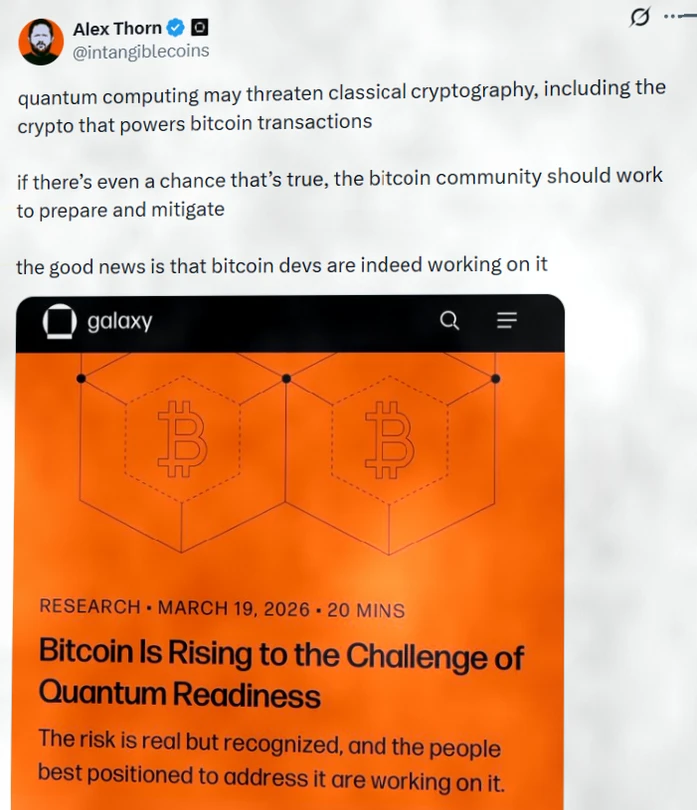
Galaxy Digital research analyst Will Owens stated that the risks posed by quantum computing to cryptocurrency investors are real, but not all types of wallets are equally susceptible to attacks. He pointed out that the teams best equipped to address this risk are actively developing solutions.
In a report, Owens explained that, theoretically, powerful quantum computers could derive private keys from public keys, allowing attackers to impersonate legitimate users, forge signatures, and steal digital assets. However, he emphasized that not all wallets face the same vulnerabilities. “In fact, most wallets are not easily attacked. Funds are at risk only when the public key is exposed on-chain.”
He further elaborated that there are mainly two scenarios in which a wallet exposes its public key: one is when the public key is already visible, and the other is when the public key is revealed at the time of a transaction.
Developers Are Actively Addressing Quantum Risks
In response to discussions online about Bitcoin core developers “ignoring and obstructing” quantum-related proposals (such as the soft fork BIP 360), Owens stated that his research found otherwise. He noted, “Since the end of 2025, the pace of proposals related to this issue has significantly accelerated.”
“Contrary to some public criticisms, our review found that developers have made substantial efforts to address quantum vulnerabilities and their mitigations,” Owens said.
Governance Will Remain a Challenge
Nevertheless, Owens predicts that when the developer community eventually proposes post-quantum solutions, their promotion will still face challenges. This is because “Bitcoin has no CEO, no board, and no central authority that can enforce software updates.”
However, he believes that “the nature of this specific threat—external, technical, and broadly impactful—can align interests in a way that differs from past disputes over the economic direction of Bitcoin.” He added, “Every honest participant in the network, from miners to holders to exchanges, has a direct economic interest in the ongoing security of the network.”