

Recently, altcoin trading activity has declined again, with the narratives that previously drove their price increases failing to effectively ignite market enthusiasm. Traders' attention has shifted from altcoin and token speculation to current hot topics.
Data shows a general contraction in altcoin trading volumes across major exchanges, indicating a weakening of investor interest. In past crypto cycles, altcoins typically saw correlated price increases driven by specific narratives. However, this cycle has not witnessed an overall upward trend for altcoins, and their performance relative to Bitcoin (BTC) faces greater scrutiny. While some altcoins with actual utility or incentive mechanisms may achieve localized growth, a comprehensive recovery of the overall altcoin market is considered unlikely.
Specifically, daily average altcoin trading volume on Binance has fallen to $7.7 billion, with total trading volume across all exchanges approximating $18.8 billion. In contrast, during the market recovery in recent months, Binance's altcoin trading volume once exceeded $40 billion.
One reason for this slowdown in token trading volume is the flow of some funds into decentralized finance (DeFi News) lending and stablecoin sectors. Additionally, some traders are turning their attention to artificial intelligence (AI) concept projects or shifting to on-chain trading of stocks and commodities.
Bitcoin Trading Dominated in March
Starting from late February, Bitcoin trading activity on the Binance platform gradually surpassed that of altcoins. Despite Bitcoin hovering around the $70,000 mark, altcoins have garnered little attention, reflecting overall market caution.
Currently, altcoins account for approximately 33% of Binance's total trading volume, a proportion comparable to the bear market period of 2022. During bull market conditions, altcoins typically represent over 60% of the volume but rapidly decline during market downturns.
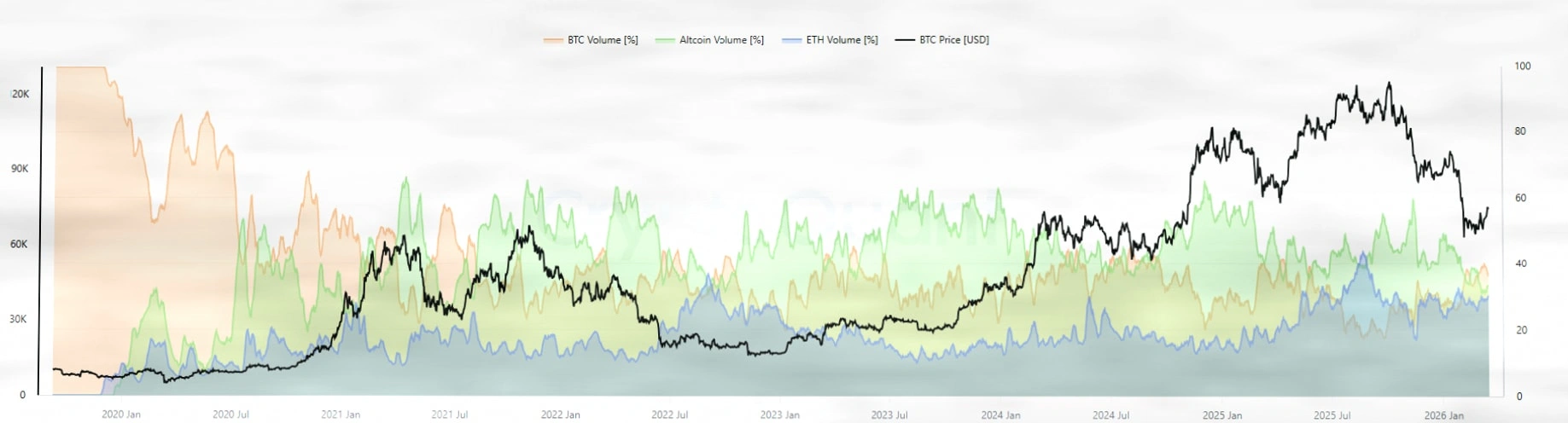
Although Bitcoin itself is also in a bear market, down 41% from its all-time high, altcoins generally underperform Bitcoin. In this environment, traders are more inclined to seek assets that offer hedging functions rather than high-risk, speculation-driven returns.
The altcoin market appears to have moved past the previous 'fear of missing out' (FOMO) phase, where interest in altcoins often coincided with local peaks.
Despite the overall market trend towards flatness, altcoins remain under close observation for signs of recovery and shifts in sentiment. Some projects continue to garner significant attention due to their potential application prospects or anticipated new features. Furthermore, institutional support for altcoins has weakened due to a lack of new purchasing announcements.
Binance Remains the Primary Hub for Altcoin Activity
Currently, altcoin liquidity is primarily provided by Binance, with other global exchanges allocating a small proportion of trading volume to altcoins. Binance continues to maintain its leading position with its vast token listings and active market makers.
Some altcoins, such as PENGU, are active on the South Korean exchange Upbit. However, the influence of South Korean exchanges is relatively limited, with slow listing speeds and conservative strategies.
In addition to its own curated tokens, Binance benefits from a large number of early-listed tokens. Nevertheless, investors are more cautious about newly listed tokens on Binance, as many new listings often experience significant depreciation within weeks.