

On March 20th, the blockchain platform Hyperliquid surpassed all other blockchains in 24-hour fee revenue, generating over $2 million according to Artemis. Concurrently, a report released by JPMorgan this week sheds light on why the platform has become a favored destination for traders when traditional markets are closed.
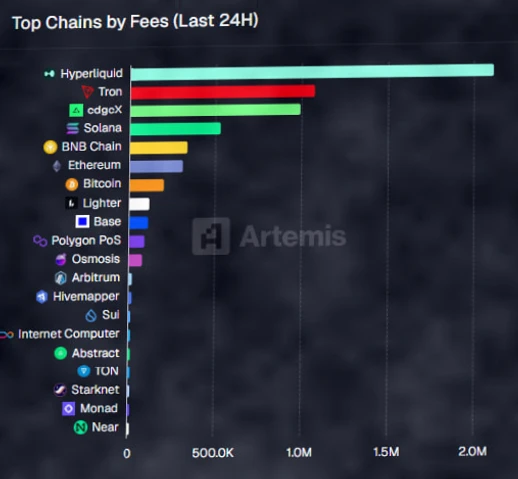
Fee revenue serves as the most direct metric for real-time economic activity on a blockchain, reflecting genuine transaction demand rather than Total Value Locked (TVL), market capitalization, or developer activity. Data from that day showed Hyperliquid's fee revenue significantly outperforming other chains. Ethereum, the processor for most global DeFi News settlements, collected less than one-fifth of Hyperliquid's fees. Solana, positioned as a high-throughput retail trading chain, generated about a quarter of Hyperliquid's revenue. Bitcoin, the largest asset by market cap, whose fees primarily stem from base layer transaction load, also lagged behind.
JPMorgan's report offers a crucial perspective on this phenomenon. The CL-USDC contract on Hyperliquid, a perpetual futures product tracking West Texas Intermediate crude oil prices, settles in USDC rather than traditional dollars. This product continuously tracks oil prices, offering cryptocurrency wallet holders the same directional exposure as CME oil futures contracts but without trading hour limitations. It has now become Hyperliquid's third-largest open interest contract, following its Bitcoin and Ethereum perpetual contracts.
JPMorgan analysts believe that Decentralized Finance (DeFi News) is filling a structural gap in traditional commodity markets, marking a pivotal moment. The report notes that a significant influx of non-crypto native investors are flocking to Hyperliquid, not out of crypto ideology, but because the platform is the only venue offering continuous crude oil price discovery on a Sunday night. The platform's on-chain limit order book, sub-second execution finality, and up to 20x leverage provide these traders with a similar experience to CME markets, but without the closing bell.
The broader implication, JPMorgan concludes, is that Decentralized Exchanges (DEXs) are eroding market share from mid-tier centralized exchanges through their 24/7 availability, trading speed, and self-custody advantages. This trend is expected to extend beyond commodities into broader markets. The fee data from March 20th suggests this expansion may be happening even faster than the report's cautious projections.
This week, Hyperliquid entered the top ten global blockchains by market capitalization, valued at approximately $9.97 billion, surpassing Cardano. This reflects the same growth dynamics from a valuation perspective, while its leading fee revenue validates it from an earnings standpoint.