Earlier today, the price of Bitcoin fell to $75,300, before slightly recovering to the current $75,600, marking a 1.8% decline for the day. This price drop is clearly influenced by institutional investors. The continuous outflow of spot Bitcoin ETF funds over the past seven days has reduced the cumulative net inflow from $5.834 billion on May 15 to $5.675 billion on May 26, a decrease of $159 million in just two weeks. During this period, the total net assets of all spot Bitcoin ETFs also fell from $10.429 billion to $9.840 billion, dipping below the $10 billion mark again.
This is not merely a single bad day interpreted as a trend. The seven consecutive days of outflows are undoubtedly a sustained action by institutional investors, rather than noise.
Actual Situation Reflected by ETF Data
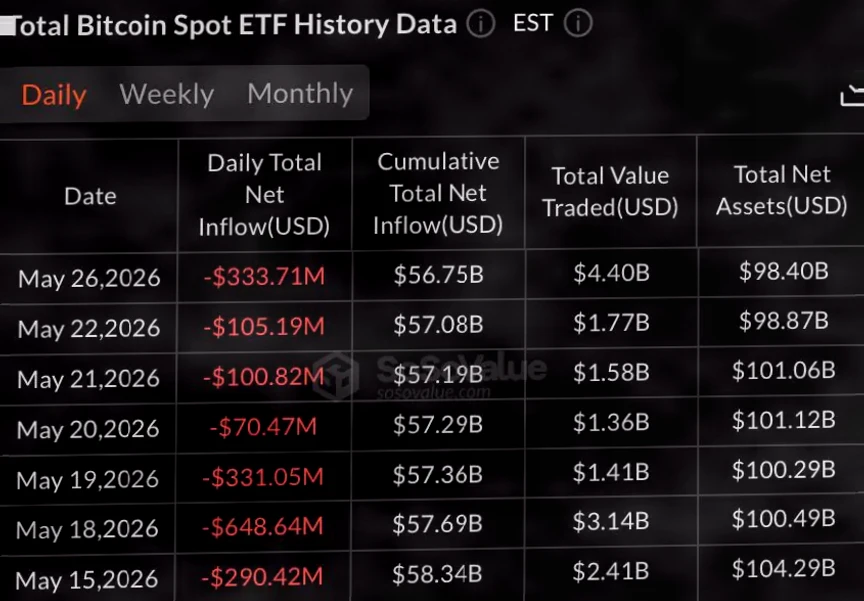
The pattern in this outflow trend is very important. After peaking at $648 million on May 18, the outflow gradually decreased to $70-105 million, and accelerated again to $333 million on May 26, indicating that it is not a single decision being gradually withdrawn. It appears more like different institutional participants selling at different speeds under the same macro conditions.
The macro backdrop driving the outflows includes unexpectedly strong inflation data reducing interest rate cut expectations, along with ongoing geopolitical pressures between Iran and the U.S. that continue to suppress risk appetite. Those institutional investors who entered Bitcoin ETFs as a risk-on trade are reducing their positions in a risk-averse environment, consistent with the $147 million outflow dynamic reported by CoinShares as of May 22.
Situation Shown in the 4-Hour Chart
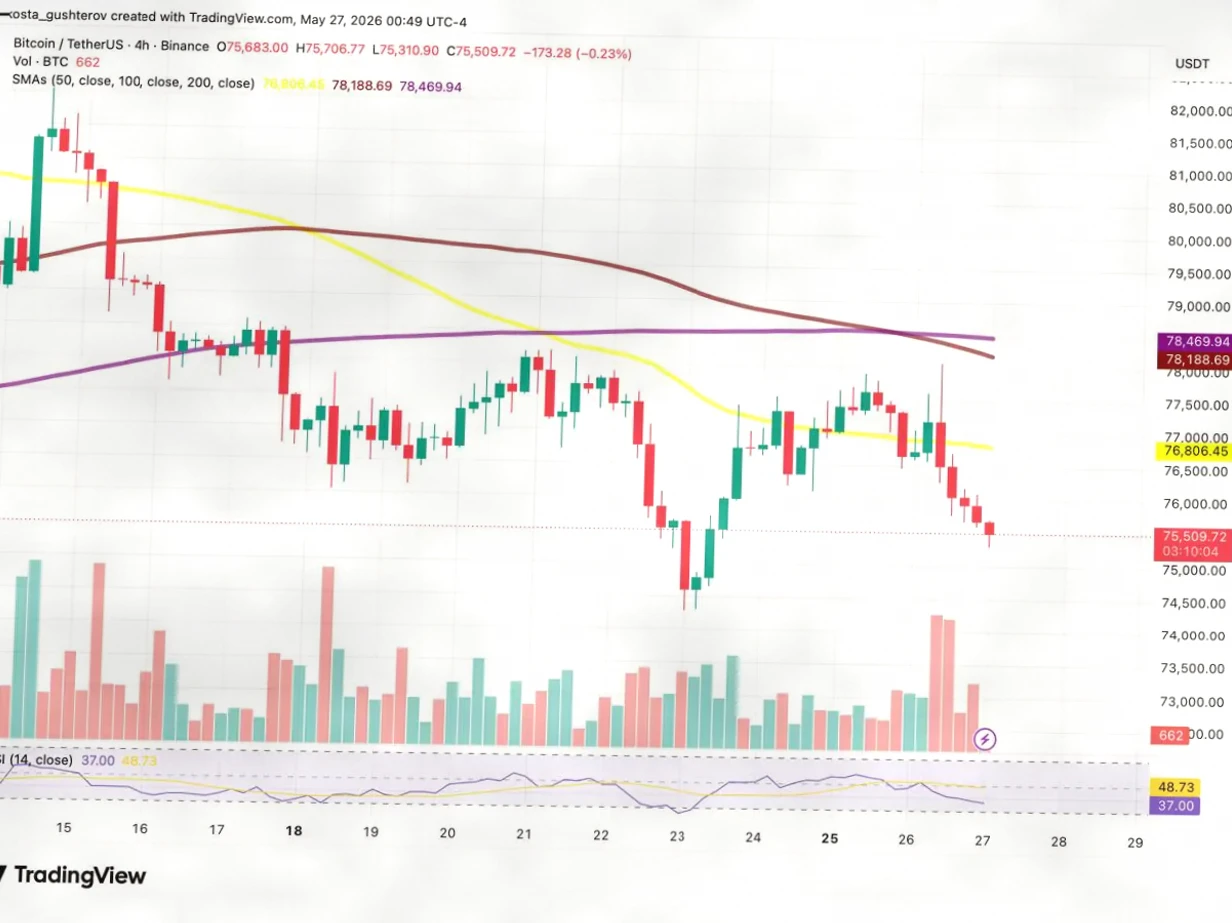
Recent candlestick volumes have increased on red trading days, indicating that selling pressure is intensifying rather than diminishing, making the current trend more noteworthy than a simple overbought correction.
Important Price Levels
The recent price action is defined by two key points.
$74,255 is the recent swing low and serves as direct support below the current price. If buyers enter at this level, the most likely path in the near term is a rebound towards the resistance range of $76,800-$78,500, which will face resistance from three descending simple moving averages. This would keep Bitcoin within a clear range until institutional fund flows stabilize or reverse.
If $74,255 is breached on a closing basis, the situation will change significantly. The CME gap is located around $67,000 and will become the next important reference point below. The CME gap represents price levels where Bitcoin futures traded but did not overlap with the spot market, historically showing a tendency to be filled. A weekly close below $75,000-$76,000 would confirm the continuation of bearish momentum, making $67,000 a target rather than an unattainable possibility.
The 30-day cumulative cost basis is close to $76,500. Bitcoin is currently trading below this level, meaning that short-term accumulators who bought in the past month are, on average, in a losing position. This will create additional selling pressure.