

This week, the controversy surrounding the U.S. cryptocurrency regulatory framework has intensified. Former President Donald Trump publicly accused large banks of attempting to obstruct the CLARITY Act, which aims to clarify rules for digital assets, stating that their delays are pushing innovation to overseas regions like China, and emphasized that Americans deserve higher returns from their assets.
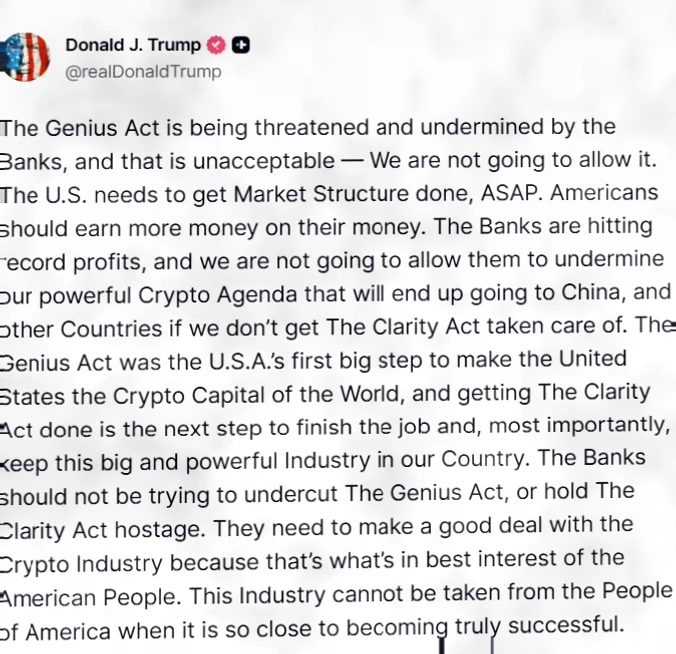
Trump views the act as a key measure to solidify the U.S.'s leadership in the global digital asset space, accusing financial institutions of attempting to 'take the legislation hostage' and undermining what he calls a 'robust crypto agenda.' He argues that regulation should leave room for innovation rather than serve as a shield for conservative forces.
In stark contrast, JPMorgan CEO Jamie Dimon firmly supports the existing financial regulatory framework. He pointed out that if companies wish to enjoy banking privileges, they must also bear corresponding responsibilities—including Federal Deposit Insurance Corporation (FDIC) protection, anti-money laundering compliance, capital adequacy, liquidity management, information disclosure, and community lending obligations.
‘Regulation cannot be completely unbalanced,’ Dimon stated, ‘otherwise, the ones who ultimately suffer will be consumers and the stability of the financial system.’
This high-level clash reflects the deepening rift between crypto-native enterprises and traditional financial institutions. As Congress is currently reviewing legislative proposals aimed at clarifying regulatory responsibilities and standardizing the behavior of digital asset intermediaries, finding a balance between innovation and risk control has become a core issue determining the future financial landscape of the United States.