Bitcoin's market cap growth is slowing, falling below the realized cap growth, indicating weakening buying pressure and accumulating selling pressure. This on-chain signal suggests a possible distribution phase, requiring observation of whether new funds can drive the price back into an upward channel.
According to on-chain data from CryptoQuant, Bitcoin's market cap growth rate has recently fallen below its realized cap growth rate. Historically, this divergence often foreshadows increased selling pressure in the market.
Market Cap is the current price multiplied by the circulating supply, reflecting the market's immediate valuation of Bitcoin. Realized Cap, on the other hand, focuses more on the cost basis—it values each Bitcoin at the price when it was last moved on-chain, essentially representing the average entry cost of all network holders. When the market cap growth rate is higher than the realized cap, it indicates that speculative buying is driving the price away from its actual cost. Conversely, it means that most holders are selling based on profit-taking or stop-loss orders, pushing the realized cost up, but the price fails to keep pace.
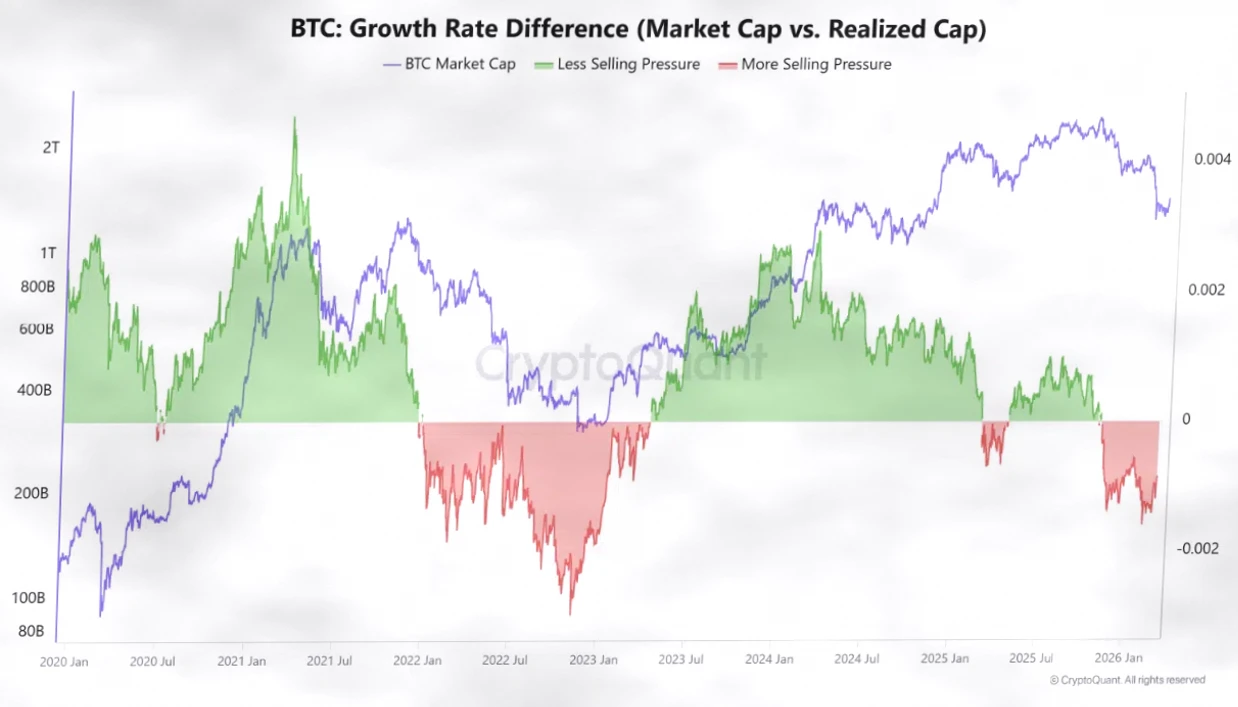
The first chart covers data from January 2020 to early 2026. The green area indicates that the market cap growth rate is faster than the realized cap, and market sentiment is optimistic. The red area, on the other hand, represents increased selling pressure. At the peak of the 2021 bull market, the green area reached a historical peak, with prices far exceeding the cost basis for most holders. During the market crash in 2022, the red area deepened significantly until early 2023, when the Bitcoin price fell to around $15,000, the realized cap continued to rise, while the market cap lagged severely.
From the end of 2023 to 2024, the market rebounded, and the market cap once again surpassed the realized cap, and sentiment turned warm again. However, entering early 2026, the chart shows that the red area has reappeared, and the growth rate difference between the two has fallen back into negative territory, suggesting that price momentum is weakening.
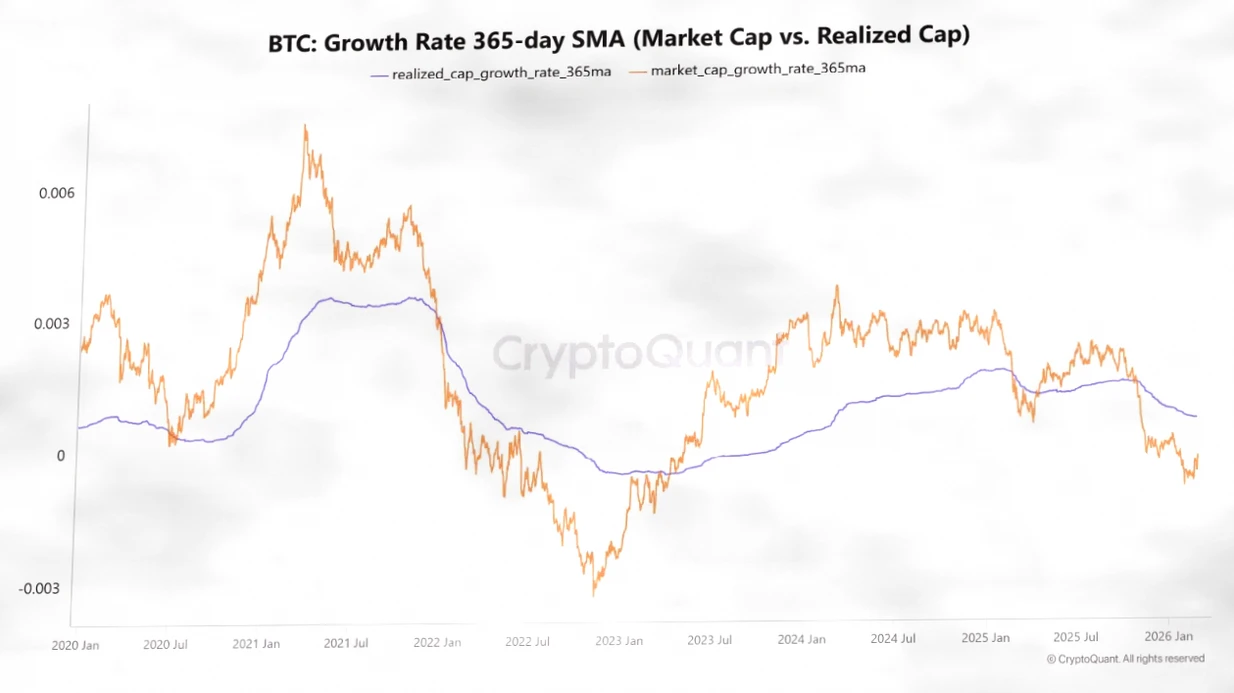
The second chart uses a 365-day simple moving average to smooth out volatility. The orange line represents the annualized growth rate of the market cap, and the blue line represents the annualized growth rate of the realized cap. At the peak in 2021, the orange line was far above the blue line. In the 2022 bear market, the orange line sharply crossed below the zero axis, while the blue line declined slowly. In mid-2023, the two converged, and in 2024, the orange line rebounded strongly. However, in early 2026, the orange line crossed below the blue line again and moved towards the negative zone, while the blue line remained at a moderate positive growth.
This crossover signal is of key significance: capital continues to flow into the network, and the realized cap is steadily rising, indicating that a large number of coin holders are not trapped; however, the price has failed to rise in sync, indicating that current buying power is insufficient, and the market is entering a consolidation or distribution phase. This does not necessarily mark the arrival of the top, but it does mean that stronger new funds are needed to continue the upward trend.
If the market cap growth rate exceeds the realized cap again in the future, the market structure will turn bullish; conversely, if this divergence continues, the market may enter a longer period of digestion, and selling pressure will be gradually released.
0 comment A文章作者M管理员
No Comments Yet. Be the first to share what you think
❯
Profile
Search
Checking in, please wait...
Click for today's check-in bonus!
You have earned {{mission.data.mission.credit}} points today