Amidst the resurgence of stagflation in the US, Bitcoin, once seen as a risk asset, is demonstrating unique resilience through its fixed supply mechanism. This article analyzes the evolution of its scarcity under the halving cycle, revealing why Bitcoin retains long-term reserve value amidst macroeconomic volatility.
The specter of stagflation is returning to the U.S. economy: geopolitical tensions are driving up oil prices, leading to a broad increase in energy costs. Simultaneously, the February labor report showed a decrease of 92,000 jobs and an unemployment rate rising to 4.4%. The coexistence of persistent high inflation and a weakening labor market is a classic characteristic of stagflation. Historical experience points to the 1970s, when the oil crisis led to soaring inflation and a simultaneous rise in unemployment. Ultimately, the Federal Reserve, under Paul Volcker, forcefully suppressed inflation with interest rates approaching 20%, at the cost of a deep economic contraction.
In 2022, against the backdrop of high inflation and aggressive interest rate hikes by the Federal Reserve, Bitcoin plummeted in sync with tech stocks, behaving like a high-volatility risk asset rather than a safe haven. However, in 2023, with the outbreak of the U.S. banking crisis, the market's focus shifted from inflation to financial stability, and Bitcoin bucked the trend, rising nearly 80%. The same asset exhibiting drastically different behavior patterns within two years due to changes in dominant risks indicates that its response to macroeconomic pressures is not fixed.
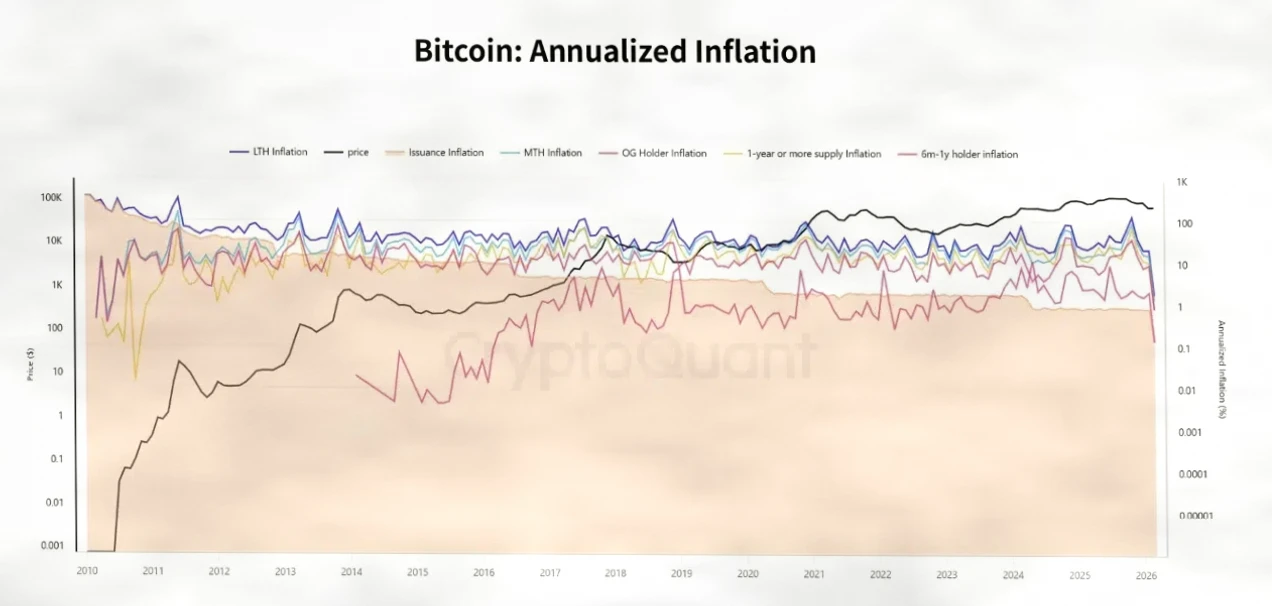
Julio Moreno, Head of Research at crypto data analysis firm CryptoQuant, published a key chart tracking the annualized inflation rate of Bitcoin across different holder groups from 2010 to early 2026. The right side of the chart shows the percentage of inflation rate, and the left side shows the price of Bitcoin (both on a logarithmic scale). Multiple curves represent new coin issuance inflation (orange), long-term holder inflation (blue), mid-term holder inflation (cyan), original holder inflation (pink), supply inflation over one year (yellow), and supply inflation from six months to one year (dark pink). The shaded area below represents the lower limit of overall supply inflation.
All curves show a continuous downward trend. Each halving further compresses the inflow of new coins, and the underlying threshold of supply inflation has been continuously narrowing since 2010, and is expected to continue to decline until 2026. At the same time, the price of Bitcoin has jumped from less than one cent to about $100,000. This structural scarcity contrasts sharply with the fiat currency system, where central banks can expand their balance sheets to increase the money supply under economic pressure, while Bitcoin's total supply and issuance rate are strictly locked by algorithms.
This immutability on the supply side constitutes the core logic that distinguishes Bitcoin from traditional assets. Even during periods of macroeconomic turmoil, its scarcity mechanism continues to strengthen, providing underlying support for long-term value storage.
0 comment A文章作者M管理员
No Comments Yet. Be the first to share what you think
❯
Profile
Search
Checking in, please wait...
Click for today's check-in bonus!
You have earned {{mission.data.mission.credit}} points today