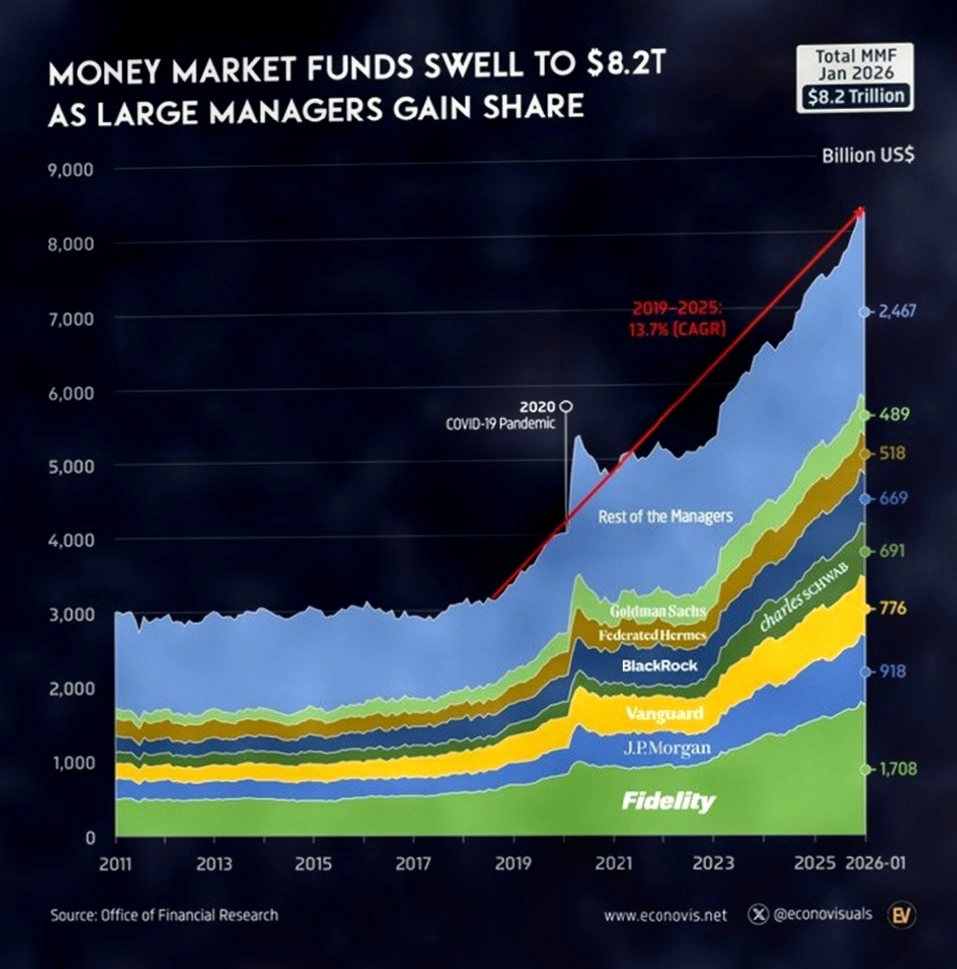
As of January 2026, US money market fund assets exceeded $8.2 trillion, with five major institutions controlling nearly 60% of the funds. In a high-interest rate environment, these funds have become mainstream cash alternatives, but large-scale funds have not yet shifted to crypto assets, and the market is awaiting a turning point in macroeconomic policy.
As of January 2026, total assets in US money market funds reached a record $8.2 trillion, a 58% increase compared to December 2022. This growth was primarily driven by five large financial institutions, which collectively control nearly 60% of the market's funds.
According to data from the Office of Financial Research, money market fund assets remained relatively stable between $2.5 trillion and $3 trillion from 2011 to 2019. The COVID-19 pandemic triggered a massive shift of funds towards low-risk assets, making 2020 a key turning point. Since then, asset size has entered a period of sustained high-speed expansion, with an average annual compound growth rate of 13.7% between 2019 and 2025, reaching a historical high.
Currently, Fidelity leads with $1.708 trillion in assets, almost double that of second-place JPMorgan Chase ($918 billion) and far exceeding third-place Vanguard ($776 billion). BlackRock ($669 billion) and Charles Schwab ($691 billion) follow closely behind. These five institutions collectively hold approximately $4.76 trillion, accounting for 58% of the total market and contributing nearly 70% of the growth over the past three years.
The remaining $2.467 trillion is held collectively by numerous small and medium-sized managers. Although this is the largest aggregate amount, it is widely distributed. These funds continue to attract capital due to the higher short-term yields under the Federal Reserve's interest rate hike cycle, making them an attractive cash alternative to traditional stocks and risk assets.
Notably, this vast amount of liquidity has not yet shifted to higher-risk assets, including cryptocurrencies. Although the market has long anticipated that interest rate cuts will drive funds from money market funds to the stock market and even crypto assets, this migration has not yet occurred. Funds continue to flow in, reflecting investors' cautious attitude towards risk and their preference for certainty of returns.
In this context, the upward momentum of crypto assets remains highly dependent on a shift in the macro environment, especially a turning point signal in the Federal Reserve's monetary policy.
0 comment A文章作者M管理员
No Comments Yet. Be the first to share what you think
❯
Profile
Search
Checking in, please wait...
Click for today's check-in bonus!
You have earned {{mission.data.mission.credit}} points today