

Research indicates that excessive reliance on artificial intelligence tools in the workplace is triggering a 'brain overload' phenomenon among employees, contrary to AI's intended purpose of alleviating work pressure. A survey of nearly 1,500 full-time U.S. employees found that 14% reported experiencing psychological fatigue beyond cognitive load due to frequent use, interaction, or monitoring of AI systems, which researchers have termed 'AI brain fry'.
Many employees describe this state as a 'mental hangover' – characterized by sluggish thinking, brain fog, scattered attention, accompanied by headaches and decreased decision-making speed. Employees in marketing and human resources roles reported the highest levels of AI-related fatigue. 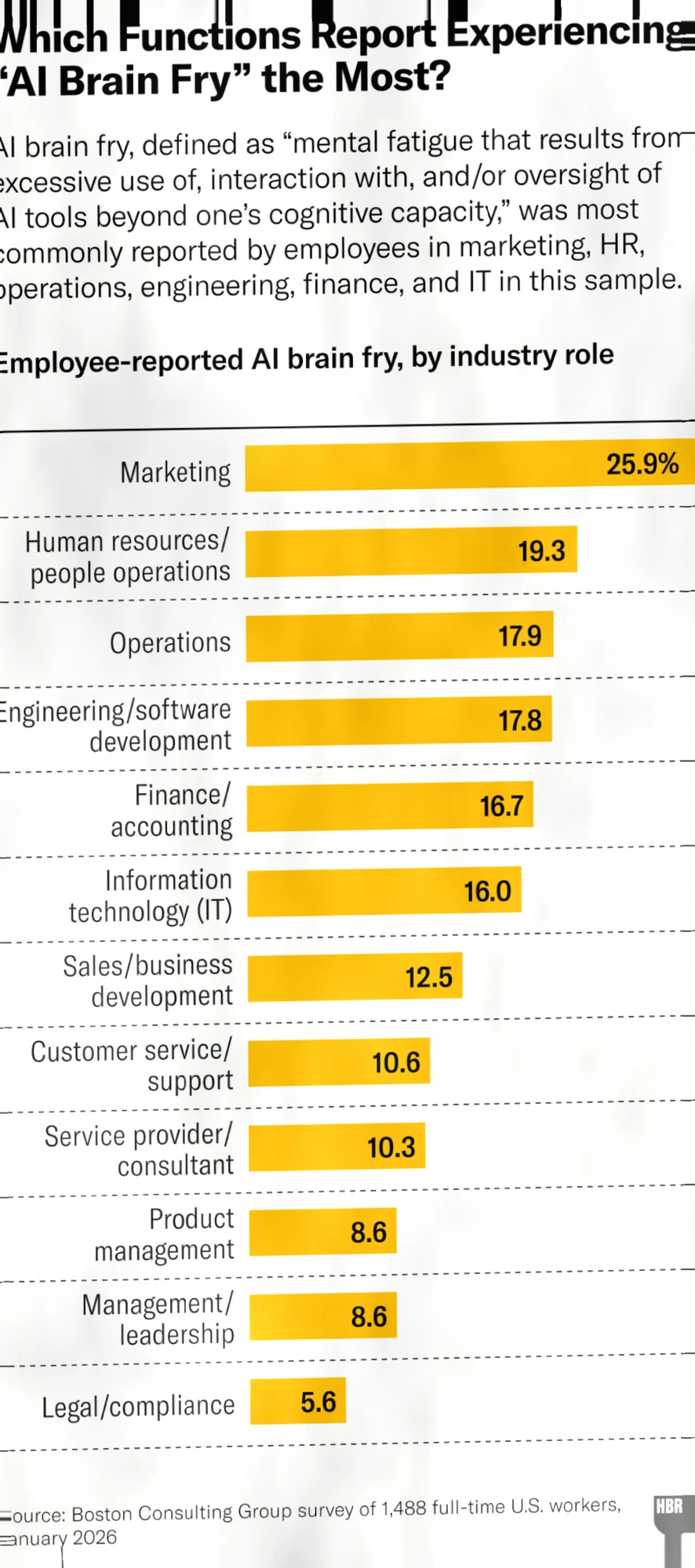
Researchers point out that as companies widely deploy multi-agent systems, employees are forced to switch frequently between multiple AI tools. Instead of freeing up time to focus on high-value tasks, they end up engaging in endless multitasking. This pattern comes at a significant cost: employees experiencing 'AI brain fry' have a 33% higher level of decision fatigue, a nearly 40% increase in major work errors (defined as errors affecting safety, outcomes, or critical decisions), and are about 40% more likely to consider leaving their jobs.
However, the research also reveals the positive aspects of AI: when AI is used to replace repetitive, process-driven tasks, employees' workplace burnout actually decreases by 15%. This suggests that the true value of AI lies not in the frequency of use, but in the way it is used.
To alleviate this problem, researchers suggest that business leaders should clarify the role of AI in the organization, clearly explaining how it reshapes workflows. At the same time, measurable outcomes should be used as evaluation criteria, rather than encouraging usage quantity, which will lead to wasted resources, declining quality, and additional psychological burden.