

Trading analyst Plan C has proposed a new study arguing that using Bitcoin's genesis block (January 3, 2009) as the starting point for price models can lead to critical prediction biases. He suggests that switching to April 6, 2009, as the anchor point not only more accurately reflects actual market behavior but also avoids the systematic flaw of models being forced to adjust their slope due to deviations in later data.
The study compared two quantitative floor prediction models, using the first two-thirds of Bitcoin's price history from July 2010 to December 2020 as training data, and then validating prediction accuracy with the remaining data. The only variable between the two models was the starting date: one using the genesis block as the starting point, and the other using April 6, 2009.
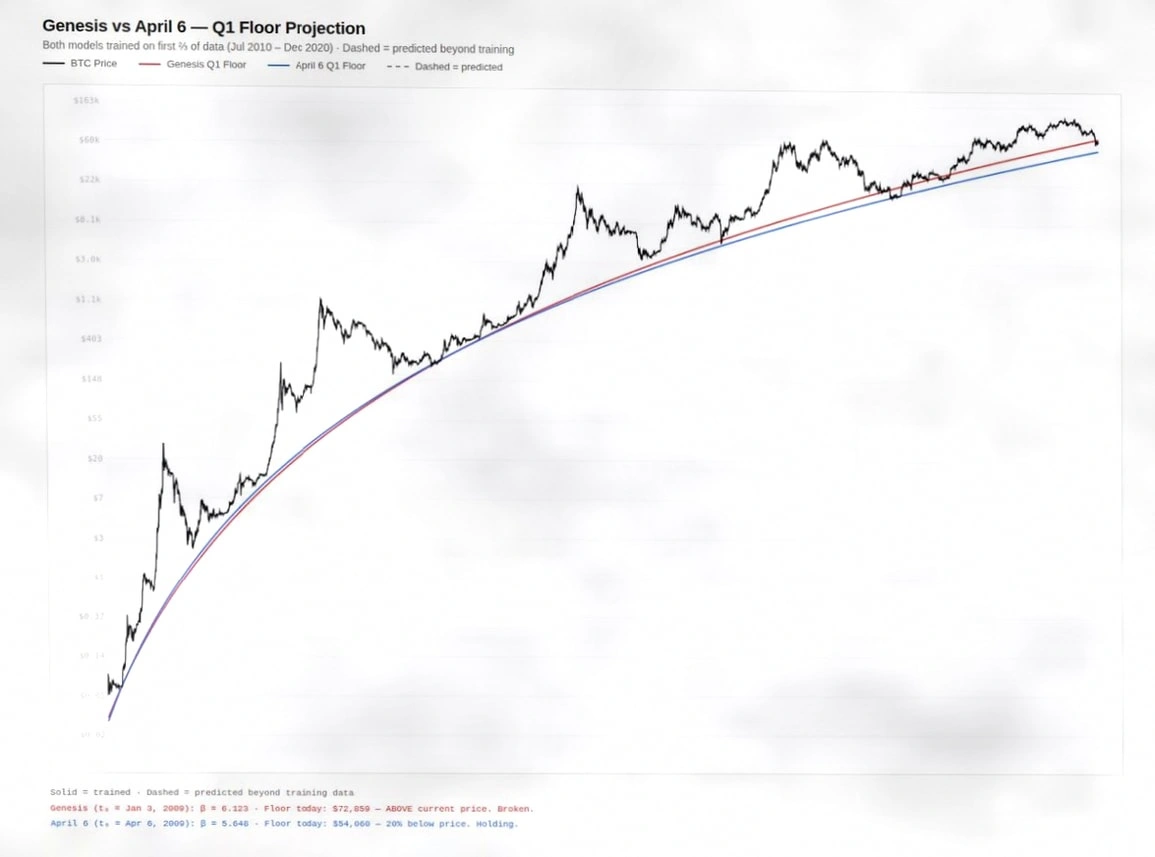
The results showed that the April 6 model performed far better than the genesis block model. It accurately captured the low point during the FTX collapse in 2022 (around $15,500) and remained stable throughout the testing period, with the current predicted first price floor at approximately $55,000. In contrast, the genesis block model saw the actual price fall below its predicted floor 12% of the time during the testing period, meaning its support level was essentially non-existent. To address this deviation, the model was forced to adjust its slope downward, ultimately pulling the predicted floor down to around $59,000.
This slope drift is the core sign of model failure. A true predictive model should be forward-looking, rather than passively corrected after data breaches. Adjusting the slope is not "self-repairing" but rather compensation for an incorrect initial assumption.
In power-law regression models, the choice of starting point is crucial. Because the model extrapolates based on a logarithmic coordinate system, even a few months earlier or later can significantly alter the entire curve's shape. While the genesis block is Bitcoin's "official birthday," its early months saw almost no trading activity, with prices remaining at zero for an extended period. This introduces a large amount of meaningless noise, weakening the model's ability to capture signals. April 6, 2009, is speculated to be the point when the network first experienced sustained node interaction and value discovery, making it a more suitable starting point for price behavior.
Plan C emphasizes that a model that cannot hold its predicted floor during market turmoil essentially has no predictive value. The genesis block model not only failed during the FTX event, but it would also have failed again during the current pullback from $100,000 to $60,000 if the slope had not been artificially lowered later. A truly robust model should accurately depict market structure without requiring post-hoc corrections.
The April 6 model, on the other hand, demonstrates greater robustness: it did not become inaccurate due to dramatic market fluctuations and did not require parameter adjustments, proving that its starting anchor point is closer to the beginning of real economic behavior.