

According to Santiment's decade-long on-chain data tracking, the number of non-zero Ethereum wallets has reached 182.74 million, significantly surpassing Bitcoin's 58.51 million. This gap continues to widen, now standing at 3.12 times. In comparison, Tether (USDT) has 12.96 million non-zero wallets, making Ethereum's holder count 14.1 times larger. Other major tokens like XRP (7.68 million), DOGE (8.22 million), USDC (6.18 million), ADA (4.61 million), and LINK (856,700) all have significantly fewer holders than these top three assets.
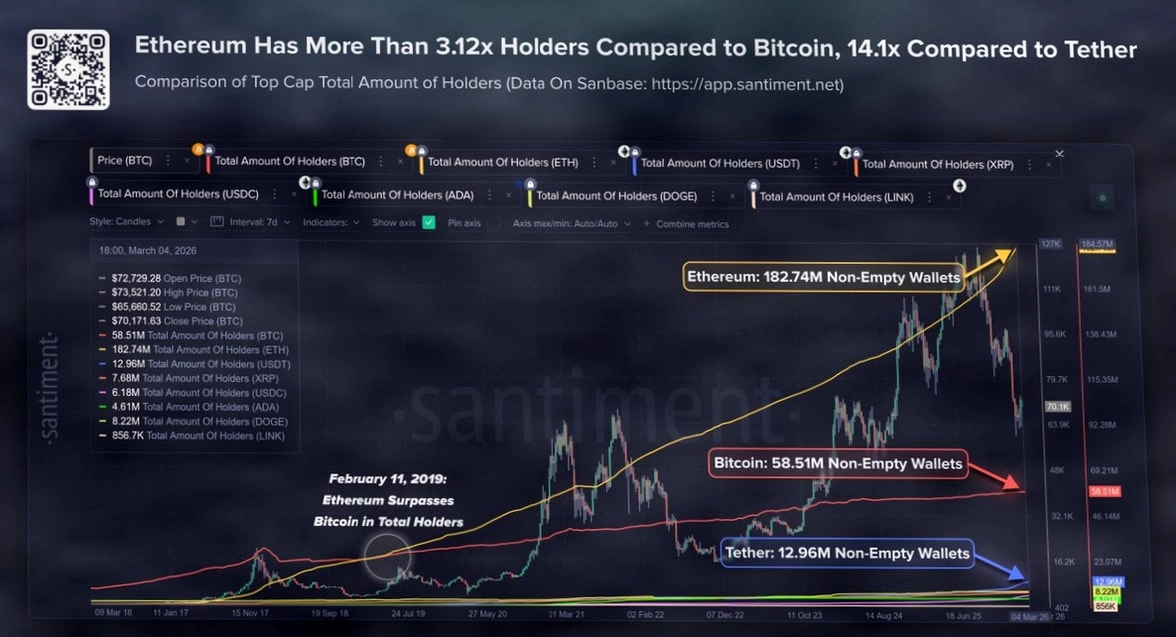
It's worth noting that the number of holders does not perfectly correlate with market capitalization rankings. Although Bitcoin remains the highest market cap crypto asset, it ranks only third in terms of holder count. Despite Ethereum's price being significantly lower than Bitcoin's and its underperformance year-to-date, its widespread ecosystem penetration continues to attract new users. Interestingly, DOGE's holder count even exceeds that of the higher market cap XRP, indicating that holder size and market valuation reflect different dimensions of network value.
Santiment points out that Ethereum first surpassed Bitcoin in holder count on February 11, 2019. While the two curves remained relatively close between 2019 and 2020, they began to diverge sharply from 2021 onwards, a trend that has not reversed since. This growth is not driven by speculative trading but is a result of structural ecosystem expansion. Every holder of an ERC-20 token, every stablecoin user leveraging USDC or USDT, every participant in DeFi News protocols or NFT transactions, and even all users bridging back to the mainnet via Layer 2 solutions, implicitly maintain or create a non-zero Ethereum wallet. As the settlement and issuance layer for the entire crypto ecosystem, Ethereum's holder growth is a natural outcome of widespread infrastructure adoption, rather than solely dependent on ETH price appreciation.
Notably, as this data was released, CryptoQuant data showed that Ethereum's transaction fee revenue over the past 30 days had fallen below Layer 2 networks such as Tron, Solana, Polygon, and Base. Its annualized realized market cap also turned negative, with ETH's price dropping approximately 30% over the past six months. This reveals a profound paradox: Ethereum boasts the world's largest crypto wallet ecosystem yet has not been able to directly capture proportional economic value from its vast user base in the short term. This precisely illustrates that Ethereum's value is being distributed across the massive ecosystem it has built—it provides the infrastructure for the entire industry, while the ultimate value capture is occurring at higher application layers and in off-chain economies.