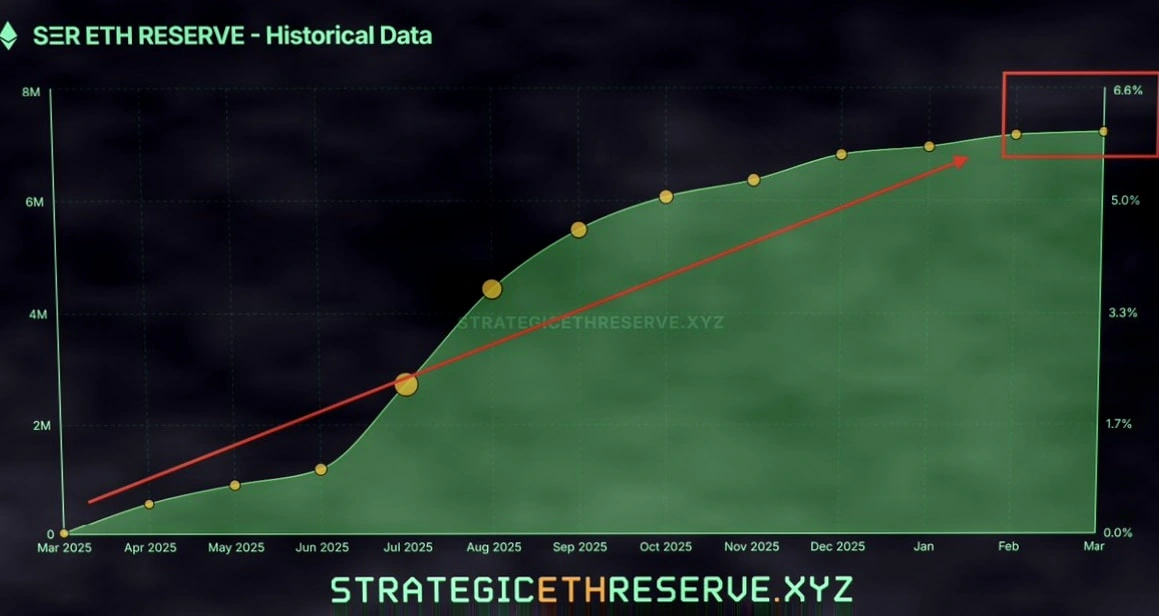
Corporate ETH holdings have surged from zero to 7.4 million in one year, representing 6.6% of the total supply. This structural shift reflects institutional long-term confidence in Ethereum, contrasting with short-term ETF outflows and reshaping ETH's circulation and holding patterns.
A year ago, no publicly traded company held Ethereum in its corporate treasury. Today, the landscape has completely changed: corporate treasuries worldwide collectively hold 7.4 million ETH, representing 6.6% of the total Ethereum supply. This growth, starting from zero, was achieved in just one year, making it one of the fastest cases of corporate-level asset accumulation in the crypto space.
According to historical data from StrategicEthReserve.xyz, the accumulation curve of corporate ETH holdings began in March 2025 and has shown a steady upward trend. Growth was moderate in the first three months, accumulating to approximately 1 million ETH by April and exceeding 2 million ETH by June. Since July, the growth rate has accelerated significantly, reaching 4 million ETH in August, surpassing 6 million ETH in October, and stabilizing at 7.4 million ETH in early March 2026.
This growth is not driven by a single giant but by a composite trend formed by multiple companies gradually joining in. As of now, Bitmine Immersion Technologies is the largest corporate holder with 4.534 million ETH, accounting for 3.76% of the total supply. The remaining approximately 2.9 million ETH are distributed among more than ten publicly listed companies, all of which have incorporated ETH into their balance sheets based on long-term strategic deployments.
It is worth noting that the increase in corporate holdings contrasts sharply with short-term market movements. Over the past six months, the price of ETH has fallen by approximately 30%, and Ethereum ETFs have experienced cumulative net outflows of $340 million (CoinShares data). Furthermore, the underlying protocol revenue has been surpassed by Layer 2 solutions such as Base and Tron. However, corporate treasuries continue to buy, demonstrating a different time horizon than ETF investors: the former focuses on strategic allocation over several years, while the latter is driven by quarterly performance pressure and tends to reduce holdings or switch to Bitcoin.
This structural divergence reveals a deep-seated discrepancy between short-term institutional sentiment and long-term corporate conviction in the Ethereum market. The 7.4 million ETH have been permanently removed from the circulating supply; they are no longer involved in secondary market trading, and their disposal requires approval from the board of directors or shareholders, effectively creating a long-term suppression of ETH liquidity. This shift marks a crucial step in Ethereum's evolution from a speculative asset to an institutional foundational asset.
0 comment A文章作者M管理员
No Comments Yet. Be the first to share what you think
❯
Profile
Search
Checking in, please wait...
Click for today's check-in bonus!
You have earned {{mission.data.mission.credit}} points today