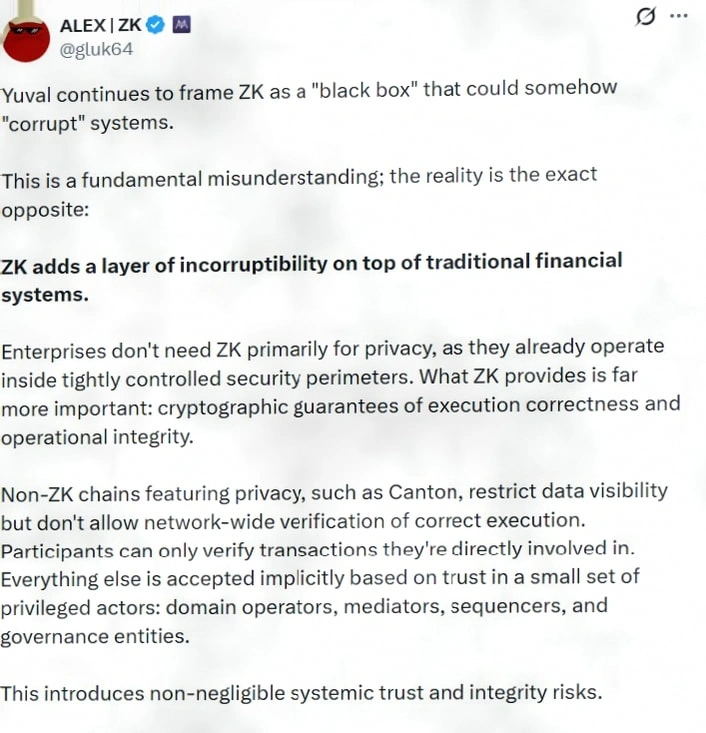
As banks gradually shift to on-chain operations through various models, the execution of financial rules has also diverged. On one hand, voices from blockchain-native developers, such as Alex Gluchowski, co-founder of Matter Labs, advocate for consistent rules across all participants in the financial system. On the other hand, institution-led networks like Canton place greater emphasis on privacy, control, and interoperability rather than a global state.
“However, this is feasible on the blockchain, especially in zero-knowledge systems combined with public blockchains like Ethereum, where all parties can trust the environment because it is not controlled by any single corporate interest,” Gluchowski stated in an interview with Cointelegraph.
The institutional adoption of cryptocurrency is driving banks and financial institutions on-chain, but it is also creating deeper divisions within the industry than geography or regulation.
What Constitutes a Blockchain?
Whether Canton is considered a blockchain depends on the definition of the term and the characteristics it requires.
For Gluchowski, the core feature of a blockchain is a shared ledger that allows all participants to execute rules simultaneously. He claims that Canton does not meet this standard. The network connects institutions through bilateral or trilateral relationships, where each participant can only view and verify transactions directly related to them.
“Before the emergence of blockchains, banks had to establish bilateral relationships and define how to handle edge cases through contracts and APIs,” Gluchowski said. “This merely transforms existing relationships and workflows into a tokenized form.”
He stated that Canton's model limits the guarantees that the system can provide. While participants can verify transactions they are directly involved in, they cannot independently verify system-level characteristics such as total asset supply or other rules applicable to all users. He added that such guarantees require a shared state that everyone can check.
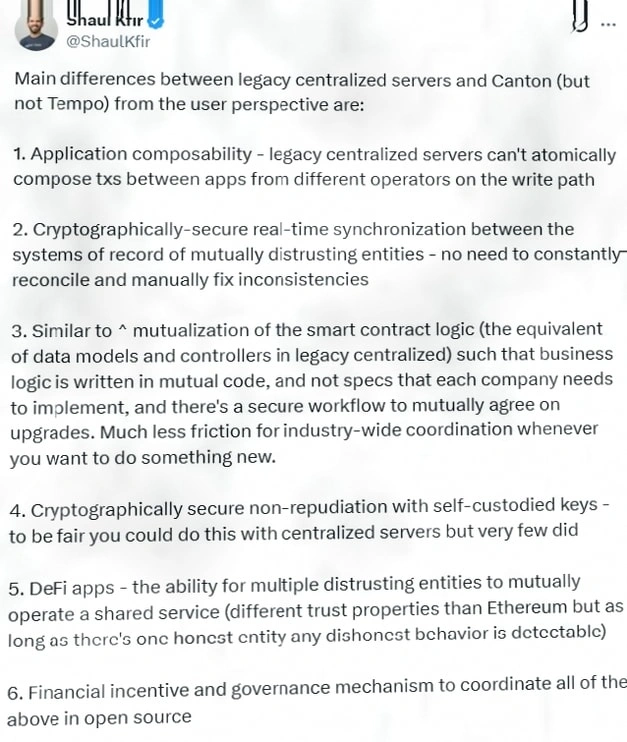
“What [Gluchowski] says about Canton lacking a global shared state is correct, but it is incorrect to imply that this negatively impacts Canton's trust model,” Digital Asset co-founder Shaul Kfir responded to Cointelegraph in a statement.
Kfir added, “In Canton, like all other blockchains, I only trust my validators, assuming that anyone else could be malicious. This ‘trust but verify’ approach is very different from a distributed API system.”
In Canton's model, trust does not come from a single perspective of the system but from each party independently checking the transactions they participate in.
Conflict Between Network Rules and Issuer Control
Rooz countered that system-level execution does not eliminate reliance on trusted parties, as the use of public blockchains