

Three Factors Reduce Supply
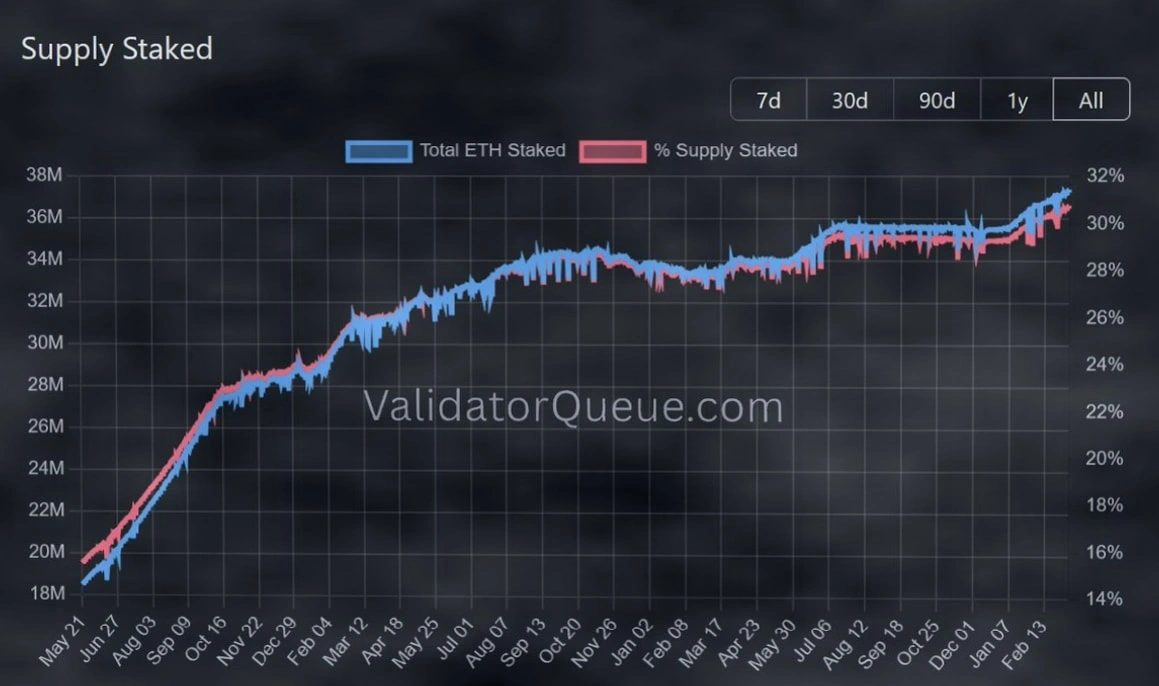
The supply situation can be categorized into three distinct categories, each developing in different directions. Staked Ethereum (ETH) now accounts for 31% of the total supply, recently setting a new record. ETH held by exchanges constitutes 12% and is decreasing, while Binance's ETH scarcity index has turned positive due to accelerated supply withdrawals. Corporate treasury ETH makes up 6.6% of the total supply, increasing from zero to 7.4 million ETH over the past 12 months.
When these three categories are combined, approximately 49.6% of the total ETH supply is either locked in staking contracts, held in corporate treasuries with a long-term perspective, or actively leaving exchanges. The freely tradable supply, which can alleviate selling pressure or meet new demand, is decreasing from multiple directions.
The staking curve on the ValidatorQueue chart tells a specific story about the accumulation speed. From May 2021 to mid-2022, the staked supply surged from 18 million to about 28 million ETH, as early validators entered the network. Since then, growth has stagnated between 28 million and 34 million for most of 2023 and 2024. The acceleration driving the current historical high is expected to occur in mid-2025 and continue unabated during the price declines at the end of 2025 and into 2026. Validators did not unstake during the downturn; instead, they increased their staking.
This situation has created a disconnect.
ETH is currently trading at around $2,023, having dropped nearly 30% in the past six months. The on-chain supply structure has never been this tight. The number of non-empty wallets has reached 182 million, the highest record for any crypto asset in terms of holder count. Daily active addresses have hit 2 million, surpassing the peak of the 2021 bull market. The staking rate of 31% has reached an all-time high, with 6.6% in corporate treasuries and 12% on exchanges, which is decreasing.
The co-founder of India's largest Bitcoin Ponzi scheme has been arrested while attempting to flee the country.
Implications of the Mathematics
Staking locks ETH for a minimum unbonding period, typically measured in days. Corporate treasuries hold ETH with a multi-year perspective, requiring board-level decisions to sell. The 12% of exchange supply is the only category that can quickly respond to price changes.
With a total supply of approximately 120 million ETH, the 12% held on exchanges amounts to about 14.4 million ETH, representing the entire trading volume of a network with 182 million wallet holders, 2 million daily active addresses, and $162 billion in custodial stablecoins. The supply compression is structural and intensifying. Ethereum's price movements are currently answering a core question in real-time: will the price eventually reflect the decrease in liquidity, or will demand destruction continue to outpace the reduction in supply?
On-chain data is becoming increasingly positive with each trading session. Price consensus has yet to be reached.