

The result solidifies a shift in the competitive landscape, considering that just eighteen months ago, Ethereum's dominance in fee generation seemed unassailable.
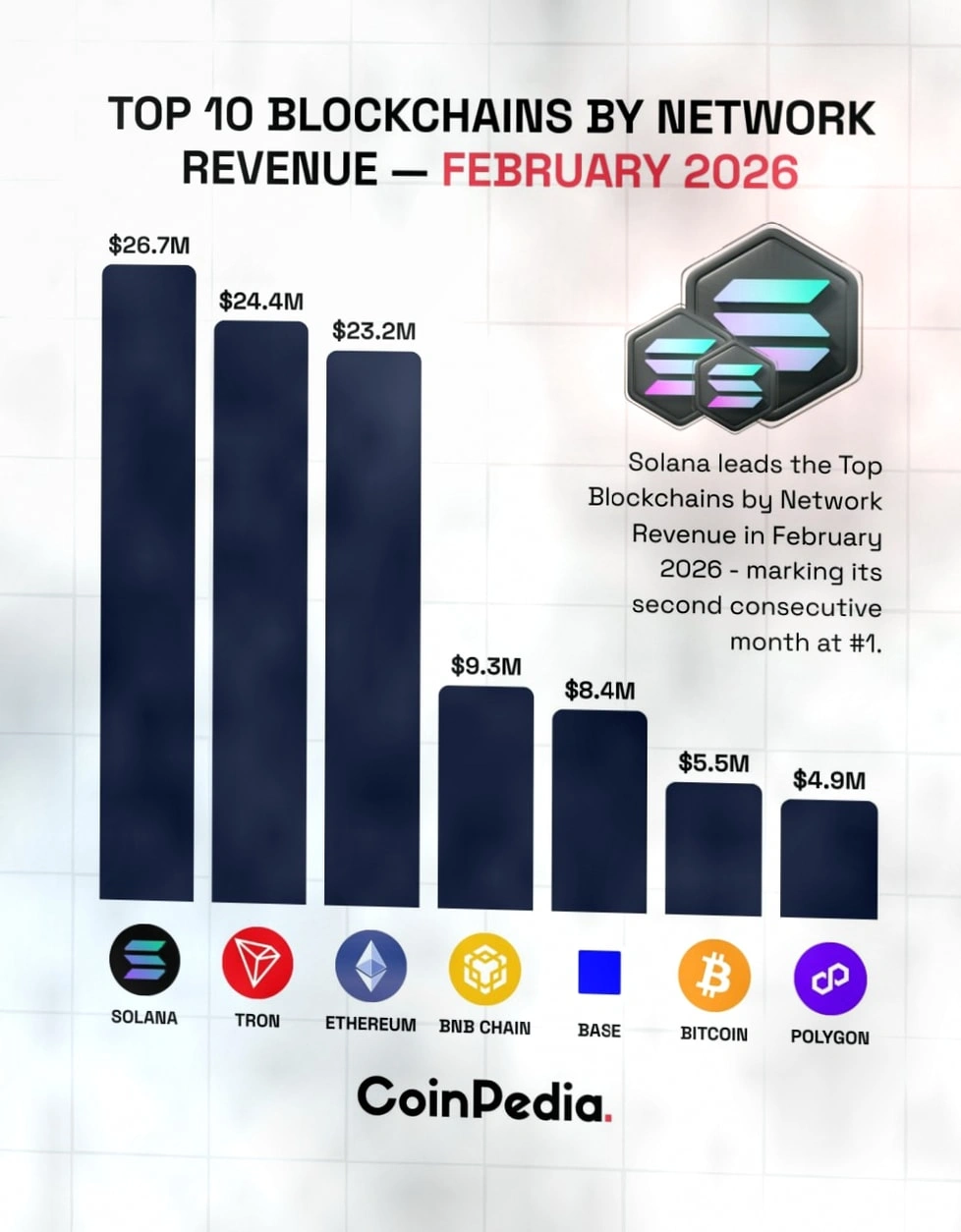
In February, Solana topped all blockchains with $26.7 million in network revenue, followed by Tron with $24.4 million and Ethereum with $23.2 million. The $3.5 million gap between these three networks significantly intensifies the competitiveness of this ranking, a rarity in previous cycles. BNB Chain ranked fourth with $9.3 million, Base fifth with $8.4 million, Bitcoin sixth with $5.5 million, and Polygon seventh with $4.9 million. The gap between the top three and other networks is significant, with BNB Chain's $9.3 million being approximately one-third of Solana's monthly revenue.
Behind Solana's Revenue Figures
Solana's continued revenue leadership stems directly from the transaction volume generated by its ecosystem through meme coin activity, decentralized exchange trading, and NFT infrastructure. In this context, network revenue represents the fees validators collect for processing transactions, so higher revenue implies more activity rather than an increase in individual fee rates. Solana's design intentionally keeps fees per transaction low, so achieving $26.7 million in monthly validator revenue requires extremely high transaction volume across the network. Recently released data from growthepie shows that Solana processed 264 million transactions in one month, a 161% year-over-year increase, providing context for the transaction volume behind the revenue figures.
Ranking first for two consecutive months carries additional significance. A single strong month could reflect a surge in specific events or short-term activity. However, topping the revenue rankings for two consecutive months indicates that transaction volume is structural rather than incidental, changing analysts' interpretation of Solana's competitive positioning relative to Ethereum.
Analysis of Ethereum's Third-Place Ranking
Ethereum's network revenue of $23.2 million in February, ranking third, requires some clarification when compared to Solana, as the raw numbers do not fully reflect the situation. Ethereum's fee structure is fundamentally different from Solana's. A portion of ETH fees are burned through the EIP-1559 base fee mechanism rather than going to validators, meaning Ethereum's total fee generation is much higher than its network revenue figures suggest. Validators on Ethereum capture the priority fee portion, while the base fee is burned, reducing the network revenue metric's reflection of what users actually spend on fees.
In contrast, Solana's fee structure directly allocates a larger proportion of collected fees to validators as network revenue. Therefore, comparing Ethereum's $23.2 million to Solana's $26.7 million is not a simple apples-to-apples comparison.