

The total supply of the global stablecoin market has exceeded $333 billion, with this capital distribution being more concentrated than at any point in history.
Of the $333 billion in stablecoins, two tokens account for 86% of the share.
When overlaying this capital distribution with the situation across various chains, the supply situation becomes even clearer. Rand Group pointed out this week that Ethereum alone holds a stablecoin balance of $179 billion, a figure confirmed by data from The Block, which has grown almost from zero since 2018 to its current level, with a sharp upward growth curve since mid-2024. Rand Group observed that institutions clearly trust Ethereum as a settlement platform, while high-frequency trading activities continue on chains with lower costs and faster confirmation times, suitable for aggressive trading strategies. The $179 billion residing on Ethereum is not trading capital but settlement capital, held by entities that prioritize finality, security, and counterparty trust.
Filling the Infrastructure Gap
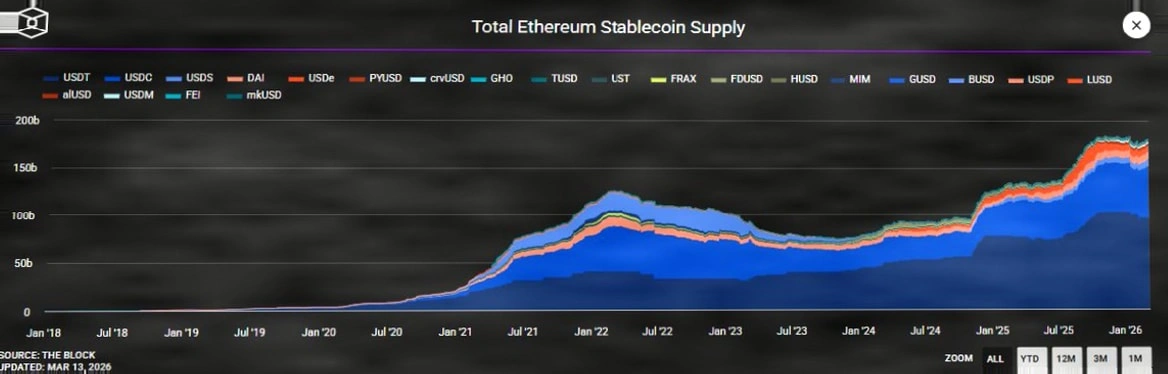
The $179 billion stablecoin balance on Ethereum has also influenced how the duopoly of USDT and USDC has evolved. These two tokens hold a significant portion of this figure, and Ethereum's institutional trust advantage means that any new stablecoin attempting to establish a significant supply faces the challenge of competing not only on product but also on the chain reputation granted by institutional allocators. Replacing the $179 billion institutional stablecoin preference is not a product issue but a trust issue, and this accumulation of trust typically takes years rather than just a few quarters.
Impact of the Duopoly on the Market
The 14% market share outside of USDT and USDC amounts to about $49 billion, distributed across hundreds of stablecoins of varying quality, compliance status, and liquidity depth. This $49 billion is not evenly distributed, with a few assets, including DAI, USDe, PYUSD, and RLUSD, accounting for the majority, while the remaining smaller stablecoins compete for a negligible share of the market. USDT and USDC have created a compound advantage that is structurally difficult for new entrants to overcome at scale, through liquidity depth, exchange integration, and the compliance established by USDC.
Whether this duopoly will further solidify or face significant erosion in the next two years largely depends on whether the wave of institutional issuers like PayPal, BlackRock, Ripple, and Stripe will generate sufficient demand to shift market share, thereby achieving the open market competition that has yet to be realized.