

In the past 365 days, the revenue ranking in the cryptocurrency industry reveals a hierarchy that contradicts the narrative of decentralized protocols and on-chain applications being the main economic engines of the ecosystem.
Tether tops all crypto projects with $5.3 billion in revenue, nearly double the $3.3 billion generated by the second-ranked Tron. Circle follows in third place with $2.4 billion.
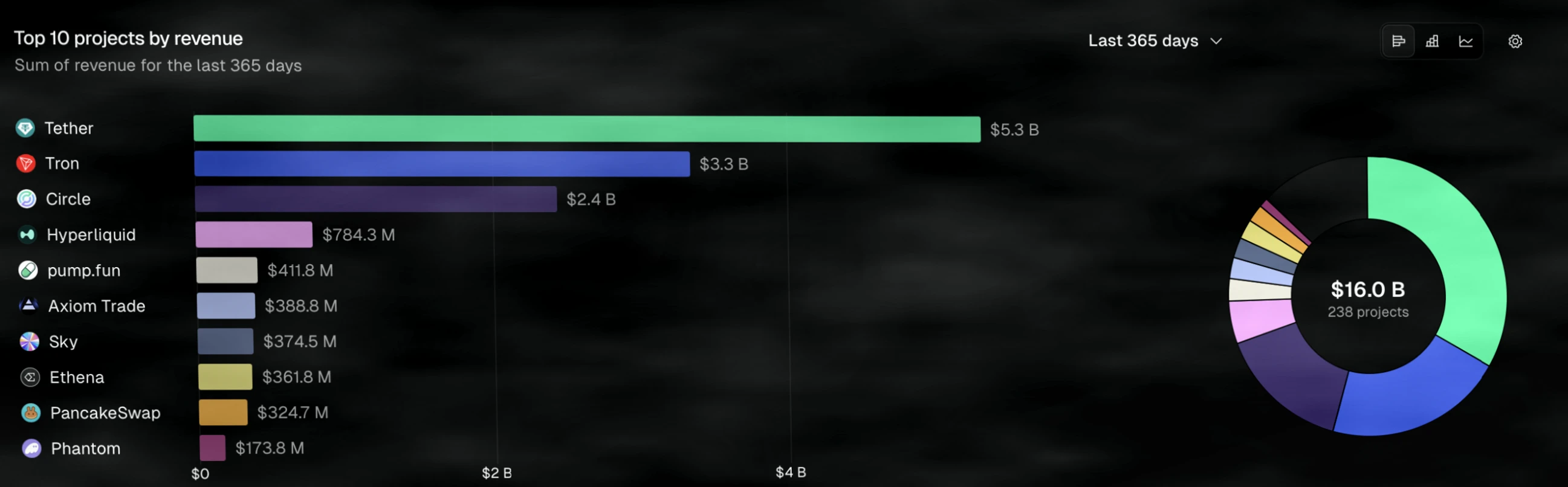
These three companies collectively contributed $11 billion, accounting for 68.75% of the total revenue of $16 billion from all 238 tracked projects. This indicates that a significant portion of the industry's revenue is concentrated in two stablecoin issuers and one blockchain network. Hyperliquid ranks fourth with $784.3 million, followed by pump.fun with $411.8 million, Axiom Trade with $388.8 million, Sky with $374.5 million, Ethena with $361.8 million, PancakeSwap with $324.7 million, and Phantom with $173.8 million.
What Tether's $5.3 Billion Revenue Actually Represents
Tether's revenue primarily comes from the earnings generated by the reserve assets backing its $185 billion USDT supply. The company invests most of its reserve assets in U.S. Treasury bonds and other short-term government securities, which maintained yields between 4% and 5% throughout the measurement period. USDT holders do not receive these earnings; Tether retains them entirely. This simplicity in the business model makes Tether's revenue data somewhat misleading when compared to protocol revenues. Tether does not earn $5.3 billion by directly providing services to users but rather profits from managing the reserves funded by these users. This distinction is particularly important when comparing Tether's revenue to Hyperliquid's $784.3 million (generated from trading fees paid directly by users of the decentralized perpetual exchange) or pump.fun's $411.8 million (derived from token issuance fees directly paid by users for every dollar of revenue).
XRP rose 5% on the day but faces a compression range that will determine its next significant move.
Tron's $3.3 Billion Tells a Similar Story
Tron ranks second with $3.3 billion, influenced by its role as the primary settlement layer for USDT transfers, particularly among users in Asian markets seeking low-cost dollar transactions. A significant portion of USDT trading volume is settled on Tron rather than Ethereum, and the fees generated from these transactions flow to the network's validators, contributing to the revenue data captured by Token Terminal through various mechanisms. While Tron's revenue is structurally more closely related to transaction fees, its underlying drivers differ from those of Tether.