

According to Artemis data, the stablecoin supply on the HyperEVM platform has surged to $879.59 million since its inception. This significant growth reflects the rapid accumulation of trading capital on the decentralized perpetual exchange, positioning it as a leader in monthly trading volume.
Chart Reveals Growth Trajectory
From the platform's launch until around July 2025, the stablecoin supply exhibited a steady and consistent upward trend, climbing from zero to approximately $300 million. During this period, the bar chart showed relatively uniform growth, indicating a stable and organic expansion without a single explosive catalyst. 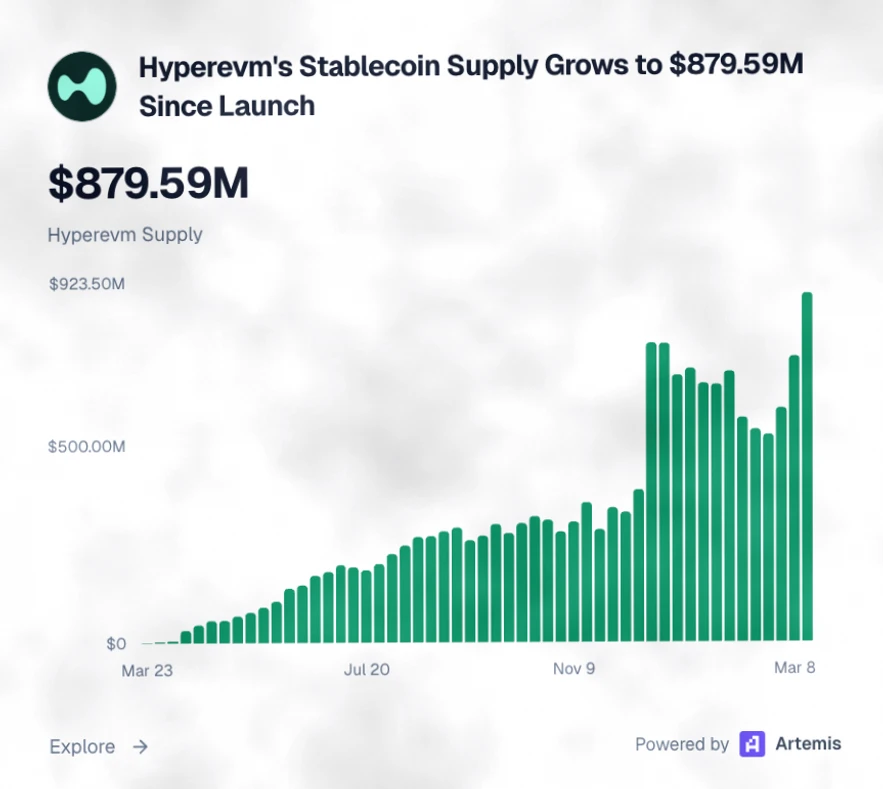
However, a notable shift occurred in November 2025. The stablecoin supply began to accelerate dramatically, rapidly increasing from around $350 million to over $500 million, then surpassing $700 million, and approaching the $900 million mark by early March 2026. The latest data point on the chart shows a peak supply of $923.5 million before settling at the current $879.59 million. It is noteworthy that the growth in the last four months depicted on the chart is comparable to, or even exceeds, the cumulative growth of the preceding two years.
Importance of Stablecoin Supply for Perpetual Exchanges
Within derivatives exchanges, stablecoin supply acts as the "fuel," representing capital deposited on the platform and available for leveraged trading. A high and increasing stablecoin supply signifies that more traders are committing funds to the ecosystem, thereby increasing the available liquidity for position sizing, funding rates, and settlements.
Hyperliquid's stablecoin supply of $880 million complements its monthly trading volume of $17.823 billion. This indicates that the platform is not only processing trading volume but, more importantly, is building a capital base to sustain these volumes over the long term.
Connection to the Broader Stablecoin Landscape
Earlier this week, stablecoin net inflow data revealed significant capital outflows from centralized exchanges, with Binance experiencing negative net inflows of $2 billion for the month. However, this capital is not entirely leaving the crypto space but is partially flowing to decentralized platforms. The growth in Hyperliquid's stablecoin supply, concurrent with declining stablecoin balances on centralized exchanges, suggests a rotation of capital rather than a simple exit.
This dynamic is closely related to the ongoing development of AI payment infrastructure by Circle and Stripe, discussed earlier this week. Stablecoins are evolving beyond mere trading instruments; they are increasingly becoming a primary liquidity layer across various on-chain ecosystems, encompassing decentralized derivatives, machine-to-machine payments, and the settlement of tokenized assets.
Hyperliquid's stablecoin supply approaching $1 billion is a manifestation of this broader trend of capital migration. The platform's growth from zero supply at inception to $880 million in approximately two years demonstrates its strong development momentum.