

A chart released by a macro analyst offers a fresh perspective on the current commodity upswing. Despite a more than 45% surge in oil prices over the past month, crude oil priced in gold has shown virtually no significant movement.
Chart Analysis
The data table shared by the analyst displays the changes in the crude oil to gold price ratio over five-year periods since 1985:
The data reveals a clear trend line. Since 1985, the crude oil/gold ratio for each five-year period has climbed by approximately 0.05. This ratio has gradually increased from 0.02 in the late 1980s to an estimated 0.40 by the late 2020s.
This steady upward trend highlights a crucial insight: over longer time spans, the price relationship between crude oil and gold exhibits a unidirectional movement.
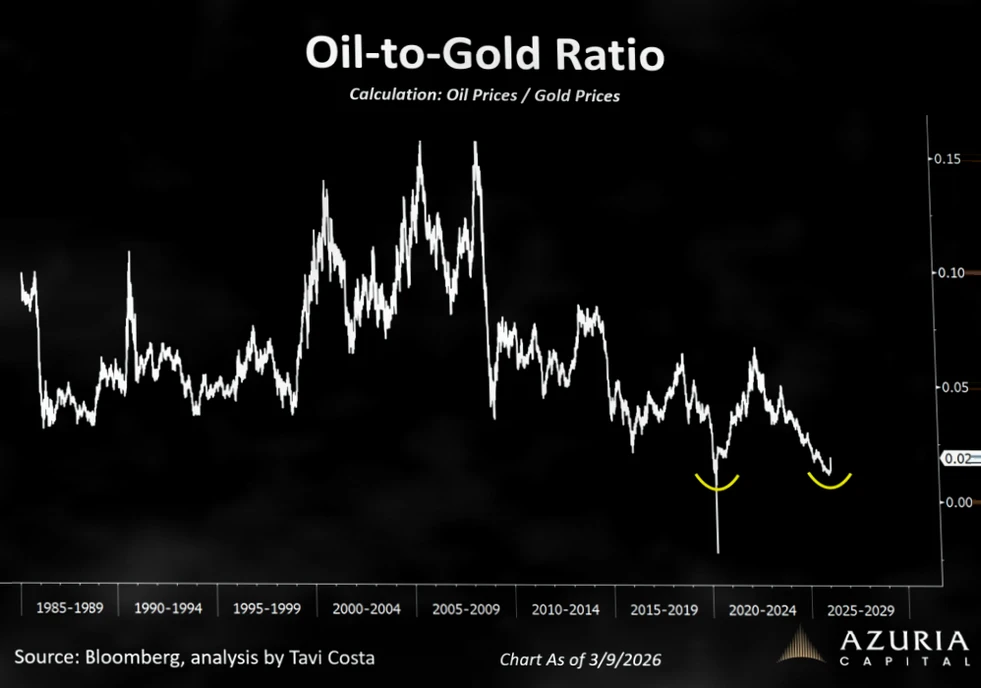
Source: X/@TaviCosta
Current Market Conditions
Recently, oil prices have experienced an explosive rise. As of March 13th, Brent crude oil touched $100.16 per barrel. While slightly down from recent highs, this represents a substantial 45% increase from the $69-$70 levels a month prior. West Texas Intermediate (WTI) crude oil is priced around $99.31, up 3.74% just yesterday.
The primary driver for this surge is the escalating tension in the Middle East. With 20% of the world's oil supply transiting through the Strait of Hormuz, the channel faces the risk of closure. Furthermore, strikes by the U.S. and Israel against Iran have heightened market concerns about supply disruptions to a degree not seen in years.
As of March 14th, gold prices fluctuated between $5019-$5021 per ounce, down approximately 1.5% from the previous day. Earlier this month, gold briefly touched $5289 before retreating to $5064. A stronger dollar has pressured gold prices, but safe-haven demand stemming from geopolitical conflicts has provided support.
Compared to the same period last year, gold prices have risen by over $2100/ounce. Some forecasts suggest that with continued central bank gold purchases, prices could soon reach $5500.
Deeper Implications of the Analyst's Chart
The truly noteworthy insight lies here: despite the formidable rise in oil prices denominated in U.S. dollars, oil priced in gold has remained virtually unchanged.
By dividing the price of oil by the price of gold, we effectively strip away the volatility of the U.S. dollar itself, offering a clearer view of the true relationship between these two hard assets.
If oil were genuinely expensive relative to gold, this ratio would be soaring. However, this is not the case; the ratio is currently within the expected range of its multi-year trend line.
This suggests that, in the analyst's view, oil prices may still be undervalued. While the gains in dollar terms appear significant, oil has not experienced excessive appreciation when compared to gold, a "hard currency.".
This is not a bearish signal for gold. On the contrary, it may further validate our entry into a new era of structurally rising natural resource prices.
Food for thought: For decades, the value of gold relative to oil has remained stable. This implies that, in dollar terms, both have been rising in tandem. While the oil/gold ratio shows a slow upward trend, the prices of oil and gold themselves, as the numerator and denominator, are climbing.
We are witnessing an economic paradigm shift. The era of cheap energy and stable commodity prices is fading. Central banks cannot conjure more oil or gold out of thin air; they can only print more dollars. This makes both assets appear more expensive when measured in fiat currency.
The escalating conflict between the U.S. and Iran further removes any doubt about the potential for worsening conditions.