

According to data as of March 15, 2026, the circulating supply of Ethereum has increased by 1,009,682.84 ETH since the merge, bringing the total supply to approximately 121.53 million ETH, with an annualized inflation rate of 0.24%.
The Meaning Behind the Numbers
The dashboard divides the supply changes into two parts. Since the merge, a total of 3,013,633.69 ETH has been distributed as staking rewards to validators securing the network, while the EIP-1559 fee-burning mechanism introduced in August 2021 has burned 2,003,950.85 ETH. The difference between these two figures has resulted in a net supply increase of over 1 million ETH, occurring over a period of 3 years and 181 days.
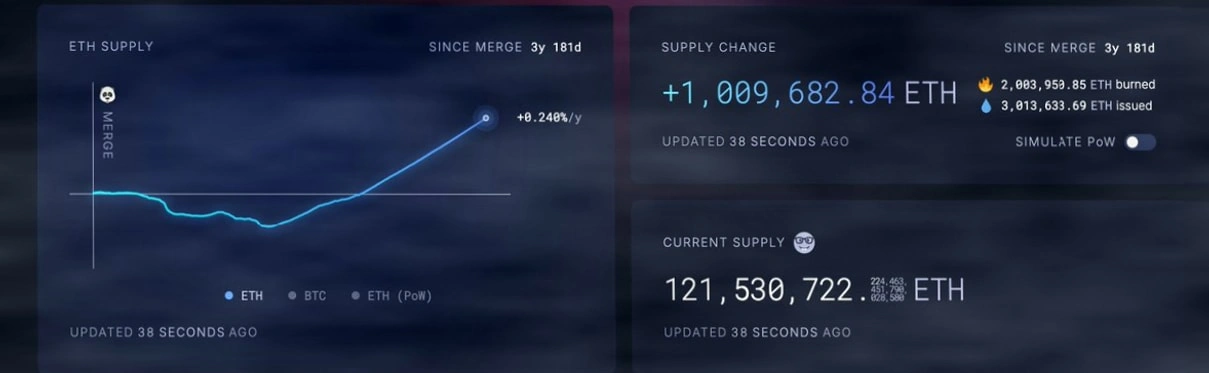
The supply chart on the left panel clearly illustrates this trajectory. After the merge, the supply line initially declined as the amount burned exceeded the newly issued ETH during peak network activity. However, as network activity slowed, the supply line began to rise slowly, currently reflecting an annual growth rate of 0.24%.
The Implications for the Deflationary Narrative
The merge was widely anticipated as a moment of structural deflation for Ethereum, as it transitioned from proof-of-work to proof-of-stake, significantly reducing the issuance while the burning mechanism continued to decrease circulating supply. High network fees during the bull markets of 2024 and 2025 led to a burning rate that exceeded issuance, resulting in negative supply growth.
The current annualized inflation rate of 0.24% reflects a different network environment. Lower transaction fees mean less ETH is burned per block. Even so, the issuance from staking continues. The slowdown in burning combined with ongoing issuance ultimately results in a moderate expansion of supply rather than contraction.
For reference, the 0.24% inflation rate is still significantly lower than Ethereum's pre-merge inflation rate, which averaged between 3% and 4% annually under proof-of-work. Additionally, this inflation rate is also lower than Bitcoin's current post-halving issuance rate of approximately 0.85% annually. From a pure supply inflation comparison, Ethereum's current inflation rate is lower than Bitcoin's.
What If There Were No Proof-of-Work?
The ultrasound.money dashboard also includes a PoW simulation switch, estimating what Ethereum's supply would be today if the merge had not occurred. Based on the issuance rate under proof-of-work, Ethereum's supply would be significantly higher than the current 121.53 million ETH, highlighting the scale of supply reduction brought about by the merge, even considering the moderate net inflation since.
Solana's Payment Volume Rises 755%: Ecosystem Chart Shows the Reasons
The Context of Staking
Since the merge, the 3,013,633.69 ETH in staking rewards represents the earnings distributed to validators. A portion of this is now retained through the Ethereum Foundation's newly announced 70,000 ETH staking program, as well as being held by institutional holders through the staking ETH ETF launched by BlackRock.