

Price Decline with Steady Revenue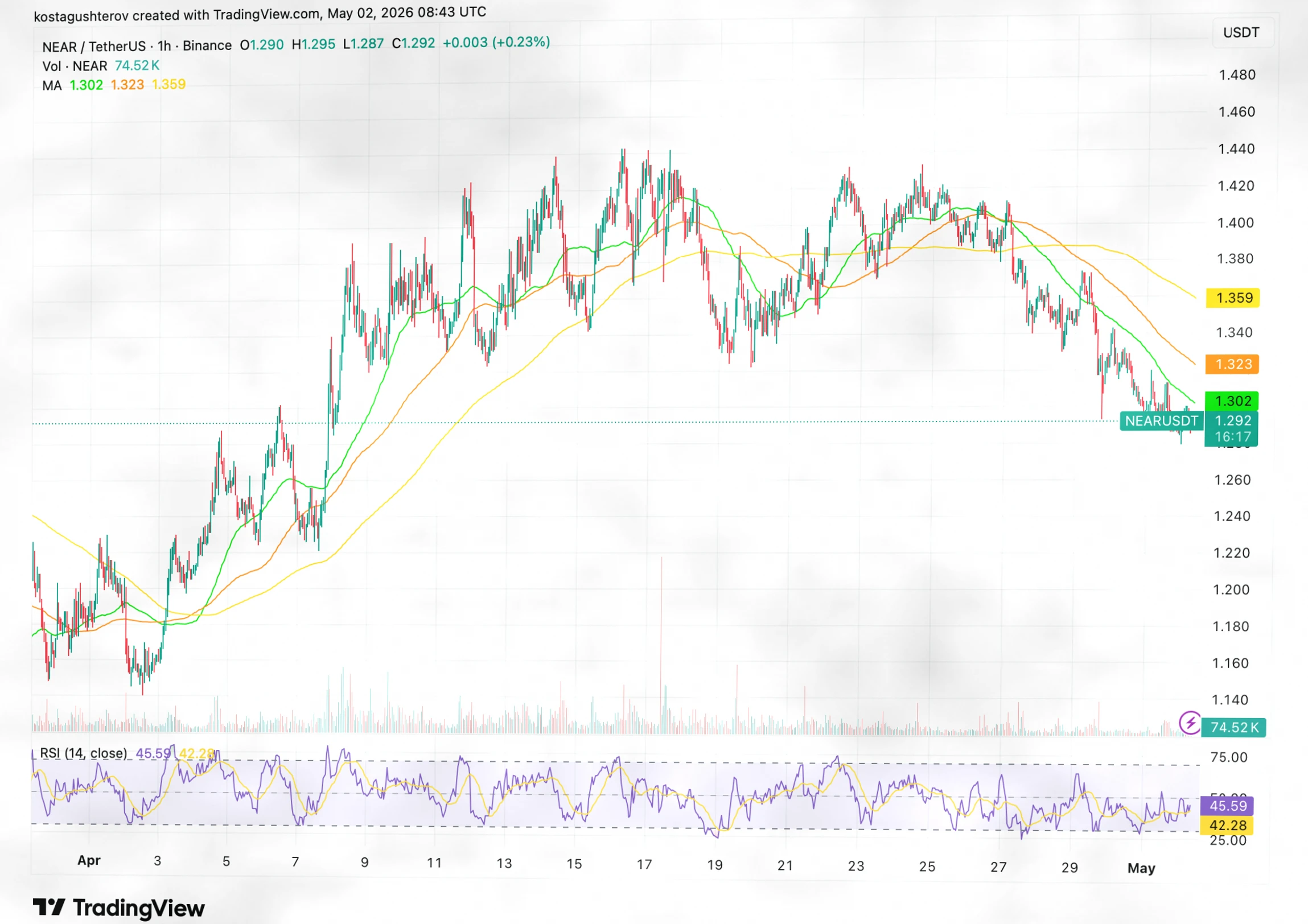
On-chain revenue data presents a stark contrast. According to analyst Michael van de Poppe's report, NEAR generated 12 million NEAR tokens in protocol revenue in the first four months of 2026, amounting to approximately $15.6 million, while the total for 2025 was only $10 million. The revenue for the first four months of 2026 has already surpassed the total for the previous year. Van de Poppe anticipates that the total revenue for 2026 will range between $40 million and $60 million, representing a growth of 400% to 500% compared to 2025. Despite the price decline, revenue is accelerating. At the current price-to-sales ratio, one of these signals clearly contradicts NEAR's future trajectory.
NEAR's Price-to-Sales Ratio Appears Relatively Cheap
The total supply of NEAR is already in circulation, and all mechanisms support the community's active use of the token.
And this is where its true value lies.
In van de Poppe's analysis, the unmentioned quality-adjusted comparisons are particularly important. With a 200x price-to-sales ratio, Ethereum commands a premium due to its most robust ecosystem, strongest liquidity, and the most institutional backing in the crypto space. Solana, with a 40x price-to-sales ratio, also enjoys a premium because it has the strongest developer momentum and retail adoption among Layer 1 competitors. NEAR, with a 34x price-to-sales ratio, is below both, but this does not necessarily mean it is undervalued. It may indicate that the market is accurately assessing whether NEAR's revenue growth can be sustained, or that its ecosystem is still relatively small and lacks liquidity compared to its peers.
The opposing viewpoint is directly mentioned by van de Poppe: the combination of AI and crypto. NEAR is positioning itself as an AI-compatible blockchain, and at this moment, AI infrastructure is attracting significant capital. Among the top ten gainers in April, SKY surged 549% and EDGE rose 96%, both being AI and decentralized physical infrastructure (DePIN) assets. The market is reassessing AI infrastructure assets. If NEAR achieves 400% revenue growth at a 34x price-to-sales ratio and has an AI positioning, then as this reassessment extends to protocols with real revenue rather than just narratives, NEAR will stand to benefit.
Solana Partners with South Korean Card Giant: Eight Projects Under Development
Conditions for Revenue Model
Van de Poppe's forecast model clearly states: $10 million in revenue for 2025, $50 million for 2026, $150 million for 2027, $300 million for 2028, $450 million for 2029, and $585 million for 2030. The annual growth percentages gradually decline, with 400% for 2026, 200% for 2027, and 100% for 2028, aligning with the standard S-curve model of technology adoption. The model predicts that by 2030, annual revenue will reach between $500 million and $600 million, which at the current 34x price-to-sales ratio would imply a market cap of approximately $17 billion to $20 billion, representing a 10 to 15 times return compared to the current $1.7 billion.
This model must meet three conditions simultaneously. First, the revenue growth rate for 2026 must continue over the next eight months, meaning the $15.6 million generated in four months needs to turn into $40 million to $60 million for the year, requiring the current growth rate to remain steady or accelerate. Second, the narrative of AI and crypto must attract sufficient capital to NEAR rather than flowing to competitors. Third, the price-to-sales ratio must remain unchanged. If the market reassesses crypto assets,