

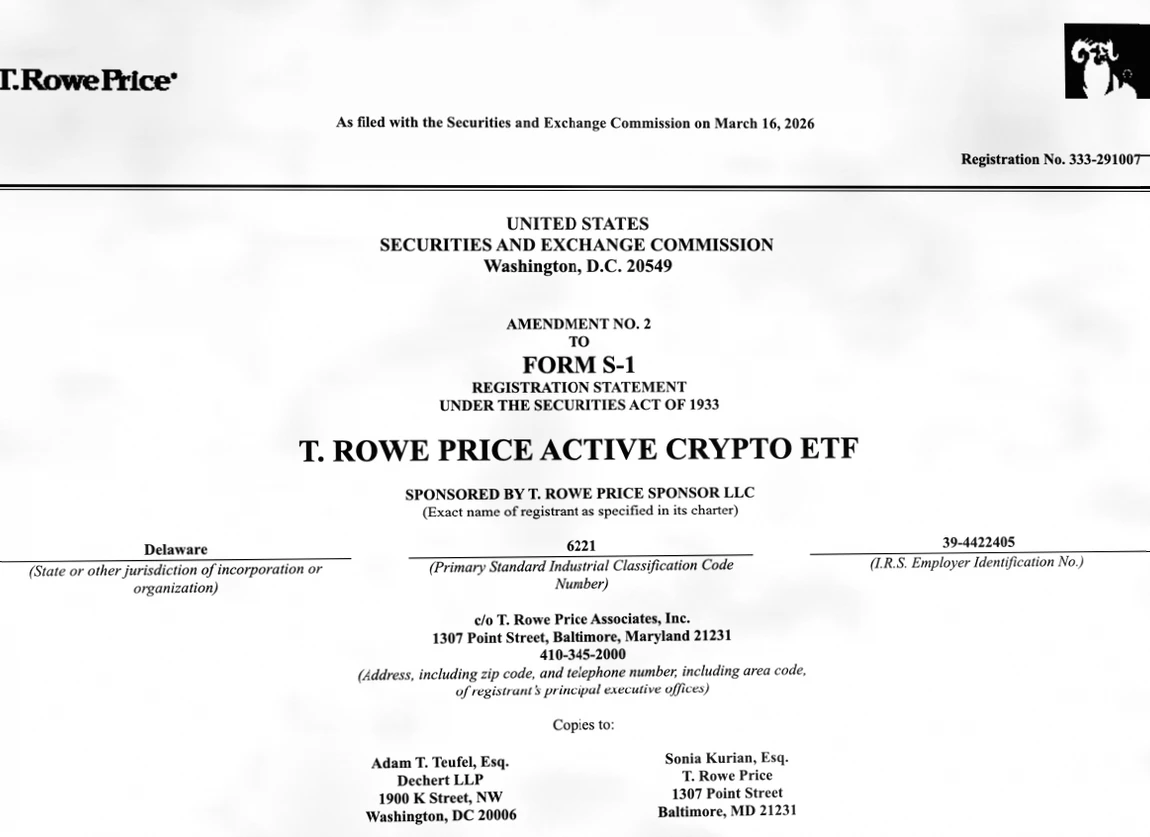
Renowned asset manager T. Rowe Price has filed its second amendment (Amendment No. 2) with the U.S. Securities and Exchange Commission (SEC) for its actively managed cryptocurrency ETF, further detailing the fund's eligible assets and operational structure as it prepares for a potential listing on NYSE Arca. Filed on March 16, 2026, this document marks a new phase in the regulatory dialogue between the Wall Street veteran and the SEC regarding cryptocurrency ETF approvals. Over the past year, the SEC has steadily advanced its approval process for crypto ETFs.
Fund Highlight: Active Management Approach
To date, most approved cryptocurrency ETFs have been passive products, tracking a single asset. For instance, Bitcoin spot ETFs and Ethereum spot ETFs follow this model, holding only the underlying asset and mirroring its price movements. T. Rowe Price, however, proposes a structurally different approach: the fund will operate under an active management model. The fund managers will dynamically allocate between 5 to 15 crypto assets based on market conditions, aiming to outperform the FTSE Crypto US Listed Index.
Active management represents a significant differentiator in the cryptocurrency space. It implies that the fund offers not only broad exposure to crypto assets but also incorporates the fund manager's 'decision-making' on the current value of specific assets. While this model introduces management risk alongside market risk, it also allows the fund to potentially avoid underperforming assets and capitalize on emerging opportunities, a flexibility not present in passive index products.
Notably, the fund will invest exclusively in spot assets, excluding leverage or derivatives. This structure aligns with the regulatory framework accepted by the SEC during the approval of Bitcoin and Ethereum spot ETFs, while significantly expanding the scope of underlying assets.
Asset Scope
The amendment confirms an extensive list of eligible assets. Bitcoin (BTC), Ethereum (ETH), and Solana (SOL) form the primary asset classes. Additionally, altcoins including XRP, Cardano (ADA), Avalanche (AVAX), Litecoin (LTC), and Polkadot (DOT) are included in the list. The filing also confirms the eligibility of Chainlink (LINK), Stellar (XLM), Bitcoin Cash (BCH), Sui (SUI), and the highly anticipated Dogecoin (DOGE) and Shiba Inu (SHIB).
T. Rowe Price's inclusion of DOGE and SHIB in its filing is undoubtedly poised to attract considerable attention. Both assets originated from meme-driven speculation and possess risk characteristics significantly different from Bitcoin or Ethereum. While their inclusion as eligible assets does not guarantee they will be held by the fund, it signifies the fund manager's discretion to allocate to them should they meet specific criteria. This discretion is the essence of active management but may also become a focal point for regulators when assessing the fund's suitability.
According to the filing, the entire eligible asset universe comprises assets that meet commodity-like properties. This structural framework allows the fund to be classified as a commodity-based trust, rather than falling under the purview of the Investment Company Act. This distinction has significant implications for how the product will be regulated.